How One Biosafety Cabinet Mistake Made Me Rethink Total Cost (and Rely on icare's Web Portal)
Last spring, I stood in our new lab staring at a biosafety cabinet that wasn't certified. The filter had failed the test. The service tech told me a replacement would run about $950. The cabinet had been delivered three weeks late. And the vendor who gave me the “great price” had stopped replying to my emails.
That cabinet was supposed to save us money. It ended up doing the opposite—and it forced me to change how I buy medical equipment.
Why I Was Comparing the Wrong Numbers
I'm the purchasing administrator for a healthcare group with about 40 providers across 5 locations. I manage the stuff that keeps clinics running—patient monitors, dental chairs, orthopedic implant orders, lab analyzers, wound care supplies, sterilization equipment. Roughly $1.7M a year across 12 or so vendors. I report to operations and finance, so I take it seriously when someone says “we need to cut costs.” It's part of my job.
When I took over in 2020, I had a simple system: get three quotes, pick the lowest, move on. It worked for basic supplies like gloves and printer paper. Then we added a small lab in early 2024 and needed a Class II biosafety cabinet. I got three quotes. A newer vendor quoted $8,400. icare quoted $10,950. The third was somewhere in between but didn't include installation either. The $2,550 difference between the lowest quote and icare was hard to ignore.
My finance director said, “Why not go with the cheaper one?” Good question. I said yes.
The $8,400 Quote That Cost More Than $12,900
The sales rep told me freight was included. “We always include freight,” he said. I knew I should get that in writing. But we'd just finished a long negotiation and I didn't want to slow things down. I thought, what are the odds we'd have a problem? Well, the odds caught up with me.
Freight wasn't included. That was $650. Then the delivery crew wouldn't take it past the loading dock, so we paid a rigging company $1,100 to move it into the lab. Then we needed independent certification—that was $1,850. Then the certification failed because the filter wasn't seated properly, and the vendor wanted another $950 to fix it. Running total: about $12,950 before we ever used the cabinet for a single sample.
The surprise wasn't just the money. It was the time. The lab sat half-empty for almost a month. Our staff had to keep using a backup hood at another site, which meant walking samples across the building. Nobody puts a cost on that in a quote.
When I compared our Q1 spend on that project against what icare had actually included in their quote, I saw it clearly: icare's $10,950 included delivery, setup, certification, a training session, and a one-year service plan. The other quote included the cabinet. That's it. Seeing those two side by side finally made me understand why unit price is just the beginning.
I only believed in total cost of ownership after I ignored it and paid the difference. Now I calculate TCO before I compare any vendor quotes.
The Same Lesson Applied to Everything
Once I started thinking that way, other purchases started making more sense. Our dialysis center needed a new machine, and I spent an afternoon learning the basics—a nurse walked me through how does hemodialysis work: blood leaves the patient's body, passes through a dialyzer, waste moves across a semipermeable membrane into a dialysate solution, and the cleaned blood returns. Simple to describe, but the machine had to be reliable, easy for staff to troubleshoot, and supported by a vendor who could get parts quickly. That's TCO in the real world: uptime, training, service, and consumables all matter as much as the ticket price.
The same logic applied when a surgeon requested a specific line of orthopedic implants. The orthopedic implant cost was one line item. But the surgical team also needed loaner trays, consignment inventory, reprocessing, and replacements for anything that expired on the shelf. Add all of that up, and the “cheap” implant set wasn't cheap at all.
Another time, I caught a hidden cost before signing by asking about consumables. The machine was fine. The proprietary tubes and sensors, though, would have doubled the annual operating cost. That's the kind of thing that never shows up in a base quote.
I started putting every purchase into three buckets: acquisition cost, operating cost, and risk cost. Acquisition is the sticker price plus freight and installation. Operating includes consumables, service contracts, and training. Risk is downtime, failed certifications, and the cost of explaining to finance why a “cheap” purchase wasn't cheap. It sounds like a lot, but it takes about fifteen minutes once you get used to it.
What Actually Changed: The icare Web Portal and Mobile Medicine
You're probably thinking, “Easy for you to say after a $4,550 mistake.” True. But the process change mattered more than the lesson.
We were already consolidating vendors in 2024, and icare became one of our main suppliers. What made a difference for me was the icare web portal. Instead of digging through email threads for old quotes and paper invoices, I could pull the full order history in one screen—including line items that usually hide the real cost. I used the portal to compare the biosafety cabinet quotes side by side before we bought another piece of lab equipment. That contrast is what taught me the lesson again.
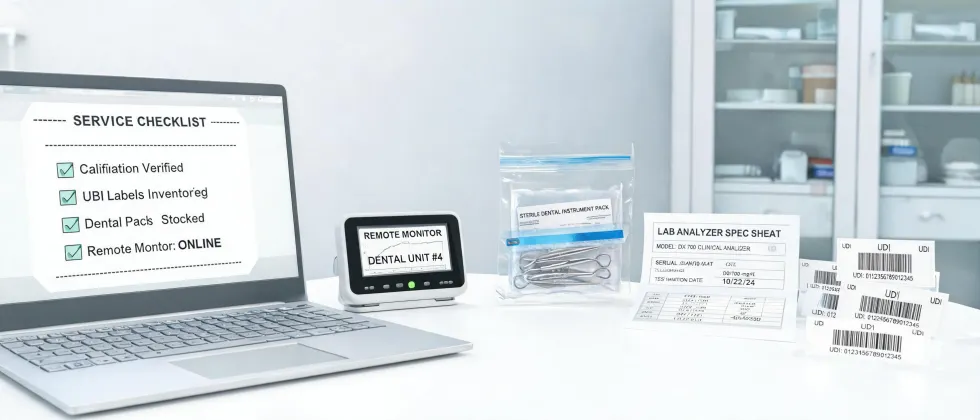
I also use the icare mobile medicine app when I'm on the floor. It lets me scan a device tag, pull up service history, and check warranty status without going back to my desk. It sounds small, but it saves me hours every month. And hours are part of cost, too.
Here's an example: a few months ago, I scanned a patient monitor with icare mobile medicine while doing an inventory audit. The screen showed it was due for calibration. That reminder didn't come from the original purchase order. If we'd skipped it, the monitor would have failed its annual inspection and possibly caused a delay in patient care. That's the kind of hidden cost no price quote will ever show.
Now, my standard process is a little less glamorous than a breakthrough. I pull the icare web portal, look at the complete service history, then build a simple TCO spreadsheet. Columns: purchase price, delivery, installation, certification, training, consumables, service contract, estimated downtime, and disposal cost. I weed out vendors who can't provide line-item prices. If a supplier says “all-inclusive” but can't show it in writing, I move on.
One more thing: I stopped treating verbal assurances as contract terms. Per FTC guidelines (ftc.gov), advertising claims have to be truthful and not misleading. But that doesn't help you when a sales rep's verbal promise isn't on the invoice. If it's not on the quote, it doesn't exist.
What I'd Tell Another Buyer
Bottom line: if a quote says $8,400, ask what happens after it arrives. Who pays for shipping? Who uncrates it? Who certifies it? What happens if it fails? What do you do when it breaks? Get every answer in writing.
I'm not saying cheaper always loses. I'm saying you can't know until you compare the full picture—delivery, installation, training, service, downtime, and the cost of being wrong. That's total cost of ownership. It sounds like consultant-speak, but for a buyer it's just arithmetic.
These days, when someone asks why I'm not picking the lowest quote, I say: “I'm not. I'm picking the one that costs less in the end.” And before I pick anything, I open the icare web portal, check the service history, and build my TCO sheet. I do not compare sticker prices anymore. The icare mobile medicine app didn't make me smarter. It just made it easier to see the whole picture.