I Manage Medical Equipment Purchasing. The Real Problem Isn't the Price.
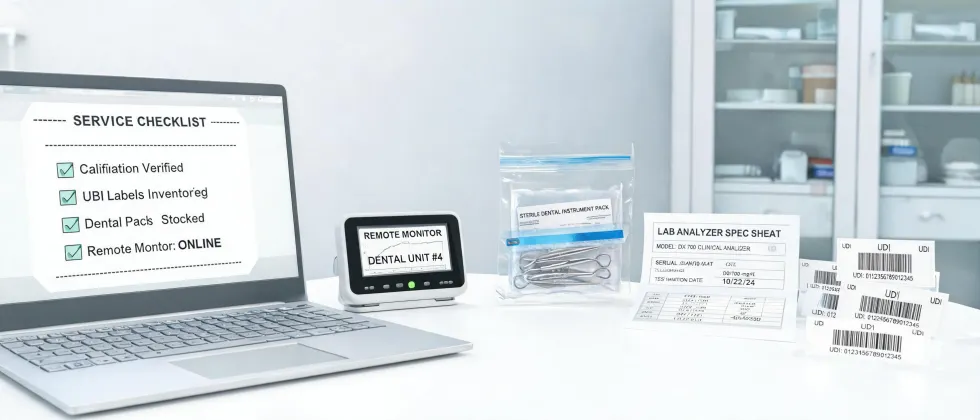
When a physician stops by my office asking for "the best price on IV catheters," I know what they're really saying. Find me something safe. Something that works. Something that won't make me look bad when a patient looks me in the eye and asks if it'll hurt. The price is almost secondary—but it's the only thing they know how to ask for.
I'm the office administrator who manages medical equipment purchasing for a mid-sized healthcare group. Roughly $2 million in annual orders across eight clinical departments. I report to both operations and finance. I've been in this seat for five years, and I can tell you: most procurement conversations are fighting the wrong battle.
The Surface Problem: Every Request Makes Sense
Every purchase request that lands on my desk is reasonable on its own.
The dental clinic wants a CBCT, chairs, and a compressor. They found a package from icare dental clinic that looks like it covers all three. Fine.
The ophthalmology team wants OCT imaging—"the highest resolution you can find." Our optometrists keep complaining the current machine can't show retinal layers clearly enough. Fair.
The surgical coordinator keeps asking "what is spine surgery going to require, equipment-wise?" and forwarding me product links for titanium retractors and pedicle screw sets. (Not that I could tell a pedicle screw from a lag screw without Google.)
Cardiology wants patient monitors. The lab wants analyzers. Infection control wants another autoclave. All reasonable.
Here's the trap: each request makes sense individually. The sum of them does not. Because every one of those departments is buying from a different vendor. And no single person—until me—was looking at the whole portfolio.
The Deep Cause: Fragmentation Nobody Owns
The real problem isn't that good medical products are hard to find. The market is full of them. The real problem is that each clinical team in our group ran procurement like a small independent business.
I'd love to say this is unusual. It's not.
From my seat, it looked like a constellation of single-product relationships. Eight vendors for patient monitors. Five for catheters and consumables. Three for imaging. Then the dental equipment, the surgical instruments, the lab analyzers, the sterilization gear. At one point we were managing relationships with 25+ suppliers, and nobody had ever counted them all before I took over.
Here's the part that took me years to fully grasp:
The individual products were almost never the problem. The coordination between them was.
I assumed a healthcare group our size had rigorous equipment integration standards. We're a well-run operation, but even we didn't have a master equipment list until I built one. I learned never to assume after discovering that two departments had bought monitors from different manufacturers that couldn't share data. Patients were being monitored on a display that didn't talk to the central nursing station. (Surprise, surprise. No one had checked.)
And once I started mapping the real costs, the pattern was unmistakable.
What Fragmentation Actually Costs
Let me be concrete. These are from my own experience, not a consultant's report.
In my first year managing purchasing, I spent two full days each month just chasing vendor portals. One supplier required the PO number in the remittance line—if it was anywhere else, they'd reject the invoice. Another couldn't produce an electronic invoice at all. (In 2022. Not because the tech didn't exist—because their office manager "didn't like computers.") The autoclave vendor's warranty ran from ship date, not install date. We lost two months of coverage on a machine that sat in crating.
Details. But details compound.
The Invoice Disaster
In 2022, I found a great price on IV catheters. About 22% cheaper than our regular supplier. I ordered a three-month supply. What I didn't verify was their invoicing setup. They sent handwritten receipts. Finance rejected the expense report. I ate $1,800 from the department budget. Not a fortune—but it wasn't my money to lose, and it damaged the trust with my finance team. Now I verify invoicing capability before I place any order.
The OCT Imaging Surprise
We bought an OCT imaging system based on a brochure that promised the best resolution in class. And it was sharp. But the ophthalmology team couldn't export images to our EHR without a proprietary module that hadn't been in the quote. The add-on cost nearly as much as a smaller competitor's entire system. The sales rep said, "You should have asked." Correct. But the cost gap wasn't obvious, and it wasn't in the marketing materials.
Per FTC guidelines (ftc.gov), advertising claims must be truthful, not misleading, and substantiated with evidence. That's the legal bar. It's not the same as knowing whether a system integrates with your existing workflow.
The Spine Surgery Complexity
Someone asked me once, "what is spine surgery"—meaning, from a purchasing angle. The honest answer: it's not one product. It's an ecosystem. Implants. Retractors. Imaging. The surgical table. Possibly navigation. All of it has to work together. Our surgeons wanted a specific retractor system; the imaging vendor's software didn't support the implant manufacturer's surgical templates. Nobody was at fault. But somebody had to untangle it. That somebody was me.
The Duplicate Service Contract
We paid the manufacturer for preventive maintenance on the dental CBCT and also paid a local biomedical tech to inspect it. Neither of them pointed out the overlap. (Not that I'd expect them to. It's not in their revenue interest.) Took me fourteen months to find the duplicate. Small line item. But it's exactly the kind of leak that adds up when you're spread thin.
The Cost of Doing Nothing
At 60-80 orders a year, spread across 25+ vendors, the hidden costs settle into a few buckets:
- Time. Vendor management, portal navigation, invoice chasing—roughly 200 hours annually. That's five working weeks. Nowhere in our budget or org chart accounted for it.
- Money. Service overlaps, warranty gaps, expedited shipping, and the occasional invoice rejection. I'd estimate $2,000–5,000 a year in direct waste. On the low end.
- Clinician attention. Every product evaluation pulled a physician away from patients. Hard to quantify. Easy to feel.
- Integration risk. The more vendors, the more opportunities for incompatible systems. And those failures are never a single vendor's fault. They're my problem.
The frustrating part was, nobody in the C-suite saw this as a problem. From their view, we had low unit prices and no major compliance incidents. The waste was invisible because it lived in minutes and fine print.
A Different Approach: Consolidation
I'm not here to tell you there's a magic formula. But in 2024, we ran a vendor consolidation project, and it changed my thinking about procurement entirely.
Instead of evaluating products category by category, I evaluated partners by breadth. Not just "can they supply," but "can they support integration across categories?"
That's what led me to icare health solutions. Their portfolio covers patient monitors, dialysis, dental equipment (the icare dental clinic package), OCT imaging, IV catheters, surgical instruments for spine procedures, sterilization, mobility aids. I was skeptical at first. In my experience, broad portfolios usually mean shallow expertise.
Turns out I was wrong. The expertise was there. But the real value wasn't any single device. It was this:
One account manager. One invoicing system. One service contract. And a vendor whose business model requires that integration work.
Everything I'd read about procurement said relentlessly quote-hunting always wins. My experience with 200+ orders across five years suggests otherwise. Relationship consistency plus portfolio integration beats marginal unit-cost savings. The product that integrates cleanly at a slightly higher price is less expensive than a cheap component that doesn't.
Did It Actually Work?
Numbers, as best I can reconstruct them:
We cut our active vendor count from 25 to 3. Monthly ordering time dropped from roughly 18 hours to 7. Invoice rejection rate went from about 11% to zero in the first quarter. (Take that last number with a grain of salt—zero was partly process changes on our side.) Costs went down maybe 6% overall. Not spectacular. But the time savings were enormous.
More importantly, the clinicians stopped complaining about integration. Patient monitors talk to the central station now. The dental clinic's CBCT connects to practice management software. The spine surgery instruments were chosen by people who looked at the whole system, not just one tool.
Final Thought
I'm not saying every clinic should consolidate into one vendor. Highly specialized needs sometimes require specialist suppliers. And icare isn't perfect—I still check their invoices line by line, same as anyone's.
But if you're the one managing fragmented purchases from 25 vendors, ask yourself this: how much of your time actually goes into product decisions, versus coordinating all the suppliers? The answer might redirect your whole strategy.
For me, it cut my evening work from several hours a week to almost none. I got Saturdays back. Not bad for a procurement decision nobody in the leadership team noticed at the time.
Something to think about the next time someone asks you for "the best price."