icare Medical Equipment: Why Device Categories Aren't Specs (ABPM, Mass Spectrometer, Fundus Camera)
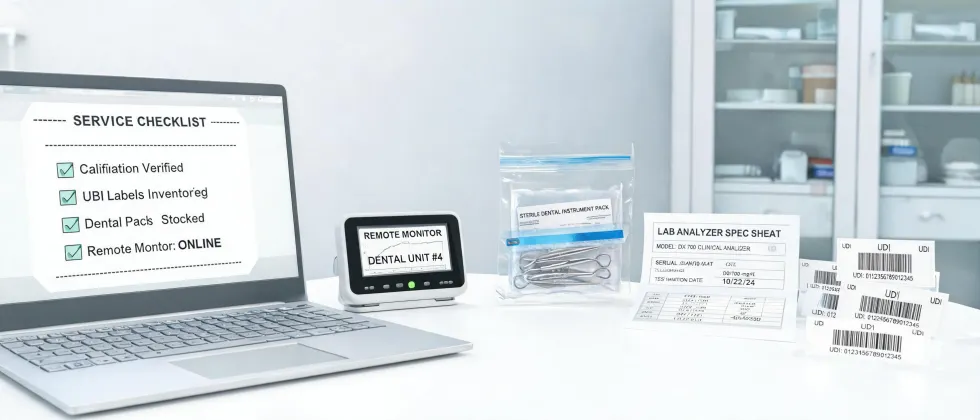
A few months ago, a clinic ordered what it called 'blood pressure monitors' for a 24-hour hypertension study. What arrived were standard home cuffs. The devices weren't defective. The requirements were.
I'm the quality and compliance manager at icare. I review every product line we offer—roughly 200+ items a year. In Q1 2025, I rejected 14% of first deliveries because the documented specs didn't match the intended use. That doesn't mean the devices were broken. It means we wrote requirements around a category name instead of a clinical problem.
The Surface Problem: The Box Looks Right
An ambulatory blood pressure monitor is not a home BP cuff. It has to be light enough and quiet enough for a patient to sleep, inflate at programmed intervals over 24 hours, store the readings securely, and produce a report a physician actually wants. If a purchase order says only 'ambulatory blood pressure monitor,' none of those requirements are captured.
A mass spectrometer is not 'a big analyzer.' A fundus camera is not a consumer camera. The category names feel familiar, and that familiarity sets us up for mistakes.
What is a fundus camera?
Plainly, a fundus camera is a medical optical device used to photograph the retina. If you search 'what is a fundus camera,' you'll get a definition in seconds. The harder question is what type you need. Non-mydriatic models can capture retinal images without pupil dilation. Mydriatic models require a trained operator to administer eye drops and manage patient flow. Both are 'fundus cameras.' They are not interchangeable.
I'm not a clinician, so I can't tell you which image resolution or field of view is right for your patient population. What I can tell you from a quality perspective is that writing 'fundus camera' on a requisition is the beginning, not the end. Also ask how images get out of the device. If it cannot export to your imaging system or EMR, the camera may add work instead of removing it.
The Deep Cause: Categories, Not Capabilities
Here's the deeper problem: procurement documents often repeat brand names and budget line items instead of specifying what the device must do. To be fair, restricted budgets are real. I get why buyers lean on a familiar brand list—it feels safer than a blank page. But a brand list doesn't tell you whether the device has the right interfaces, consumables, or service response for your environment.
Vague specs also make it impossible to compare quotes fairly. If two vendors bid on 'a mass spectrometer,' one can bid a basic unit and the other a research-grade system. The prices look different because the products are different. A procurement office can waste weeks trying to compare apples and oranges.
The more functions a device has, the more likely it is to be specified incorrectly. Feature-rich equipment looks like added value. A quality inspector sees added risk: more software to validate, more training to deliver, more ways for an operator to use the wrong setting. More isn't a specification.
The ambiguity in 'icare dental coverage'
Take the phrase 'icare dental coverage.' From a patient's perspective, that usually means insurance. From a dental clinic's perspective, coverage might mean a service plan for a CBCT scanner, a dental chair, or an air compressor. Both meanings are legitimate. But when a buying team uses a phrase like 'dental coverage' without defining what it covers, they're not writing a spec—they're hoping a good supplier will guess the rest.
When a dental office calls us because a sensor stopped working, 'coverage' usually comes down to response time. Does the provider have a local technician? Is a loaner available? What about software upgrades? Without those details, 'coverage' is an insurance word, not an equipment plan.
Mass spectrometer: 'one unit' is not a requirement
I've seen lab requisitions that list 'mass spectrometer, 1 unit' and nothing else. No ionization source. No mass range. No sample matrix. No regulatory status. Different ionization sources—electrospray, MALDI, electron impact—change what the instrument can see. A clinical lab running immunosuppressant drugs has different needs than a research lab mapping proteins.
When the vendor asks questions, the buyer sometimes calls it a delay. It isn't. It's the specification process finally working. A mass spec with the wrong inlet system can double consumable costs and extend turnaround time by weeks.
The 'buy the same model as last time' thinking worked when equipment generations changed slowly. That changed. Between 2020 and 2025, software-connected ABPMs, benchtop mass specs, and AI-assisted fundus cameras have made 'same model' a moving target. What was best practice in 2020 may not apply in 2025. The fundamentals—validation, safety, training, maintenance—haven't moved. The execution has.
The Cost of Buying a Category Instead of a Device
An urgent care center like icare urgent care ebensburg doesn't have time for a 24-hour blood pressure study to fail because the monitor wasn't matched to the patient population. The wrong device means a redone study, a confused patient, and a clinic that looks disorganized. At an urgent care facility, even a 30-minute delay in verification can affect patient throughput.
If the device is an ambulatory blood pressure monitor, it should be validated under ISO 81060-2, with cuffs that cover the range you actually see. If it isn't, you're not simply buying a lower-cost monitor. You're buying a diagnostic liability.
And a fundus camera that doesn't fit your workflow creates bottlenecks. If your ophthalmology clinic plans high-volume screening, a mydriatic-only camera may slow you down. If the goal is diabetic retinopathy screening in a community setting, a non-mydriatic model may be the better fit. The category name doesn't tell you any of this.
This is also a safety-standards issue. Under IEC 60601-1, medical electrical equipment like fundus cameras and ABPMs needs a current safety test report. As of July 2025, if a supplier can't produce that report, the purchase is a gamble no matter how good the brochure looks. Nobody wants to pay more for equipment. But the cheapest quote is only cheap if the spec is right. A service call after installation will wipe out any savings.
What Should Change: Write a Spec, Not a Shopping List
The fix is simple to describe and harder to execute: start with intended use, then add constraints. For example, instead of writing 'ambulatory blood pressure monitor,' write: 'A 24-hour ABPM for adults with arm circumference 22-42 cm, producing a structured report compatible with our EMR.' That one sentence changes everything.
- What problem will this device solve for the patient and the clinician?
- What standards must it meet? IEC 60601-1, ISO 81060-2, and relevant local registration.
- What environment will it live in? Temperature, space, power, medical gases, Wi-Fi.
- Who will use it, and what training do they already have?
- What happens when it fails? Spare parts, consumables, response time, service contract.
At icare, we use the same list when we review a product line. We ask to see ISO 13485:2016 certification and the manufacturer's validation records. We'd rather reject a first delivery than ship a device that doesn't match the intended use. That's not the fastest way to close a quote. It's the only way to build a long relationship.
The fundamentals haven't changed: a medical device is only as good as its requirements. But the execution has transformed. In 2025, buying a category name is a choice. Buying a capability is a discipline.