New vs. Refurbished Medical Equipment: A Procurement Guide From 12 Years of Emergency Orders
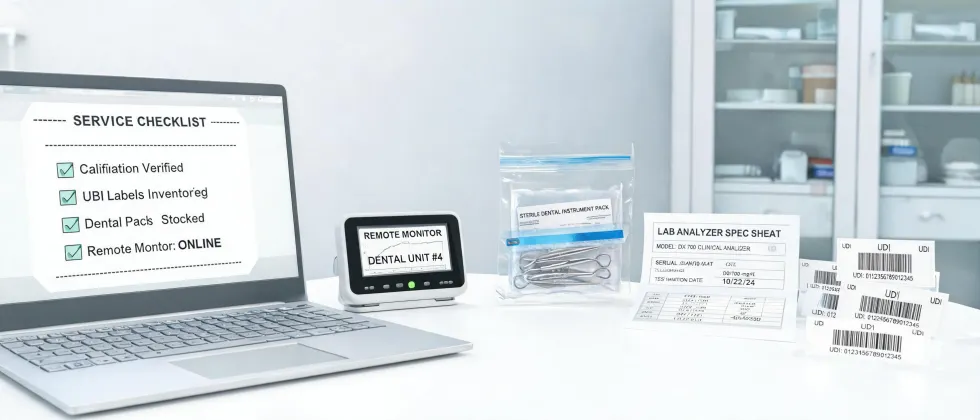
It took me 12 years and roughly 300 equipment orders to understand that "new" and "refurbished" aren't really the categories that matter. What matters—when a dialysis center loses a peritoneal dialysis machine with patients scheduled the next morning—is time to deployment, service support, and total cost of ownership. And those don't always line up the way you'd expect.
I coordinate emergency equipment procurement for icare's network of ER & urgent care centers, dental providers, dialysis clinics, and diagnostic labs. I've handled 120+ rush orders in 12 years, including same-day turnarounds for facilities that had patients waiting. I've bought new equipment with 12-week lead times and watched a clinic struggle through the gap. I've also bought refurbished equipment that shipped within 24 hours and ran flawlessly for years.
This guide compares new vs. refurbished medical equipment across four dimensions: cost, lead time, compliance, and technology lifecycle. If you're making a decision under deadline pressure—whether it's a dialysis machine, an electric wheelchair, or a diagnostics platform—here's what I've learned.
Why This Comparison Matters Right Now
Supply chains are still unpredictable. Budgets are tighter. CMS reimbursement rates aren't going up. So more facilities are seriously considering refurbished medical equipment. And honestly, it's not a bad instinct—but "refurbished" is a slippery word.
Some refurbishers are essentially remanufacturers: they tear the device down, replace entire subassemblies, and test it to factory specs. Others wipe down the exterior, swap a battery, and call it "certified." The gap between those two experiences is enormous.
The question isn't new vs. used. The question is which level of refurbishment you're actually getting, and whether it matches the clinical risk profile of your use case.
Dimension 1: Upfront Cost vs. Total Cost of Ownership
Let's start with the obvious dimension: price.
From our procurement records at icare, a new peritoneal dialysis cycler runs roughly $15,000–$25,000 depending on brand and configuration. A properly refurbished unit is typically 40–60% less—around $7,000–$12,000. Similar math applies to electric wheelchairs: $25,000+ for a new custom power chair, $10,000–$15,000 for a refurbished one. Molecular diagnostics platforms follow the same curve, sometimes with an even bigger spread.
But the invoice price is just the opening bid.
What I actually care about is total cost of ownership (TCO)—i.e., what the device really costs you over its working life. And here's the counterintuitive part: refurbished equipment often has lower TCO than new, because the steepest depreciation has already been absorbed by the first owner. If the refurbisher does their job, you're getting 3–5 solid years of service at a fraction of the entry cost.
That said, I've learned where this breaks down. We purchased two "refurbished" ventilators in 2022 from a reseller we'd never worked with. Within six months, both needed $3,000+ in repairs, and parts took ten weeks to arrive. By year two, we'd spent more than the cost of buying new. (Note to self: vet the refurbisher before you vet the price. Always.)
My conclusion: The sticker price is the single least reliable metric in this comparison. What matters is the device's history, whether critical components (pumps, batteries, compressors) were actually replaced, and who stands behind the warranty.
Dimension 2: Lead Time—Where Refurbished Crushes New
This is the dimension that surprises most procurement officers, and it's the reason I've steered facilities toward refurbished equipment in urgent situations.
New medical equipment, particularly dialysis machines, patient monitors, and imaging systems, typically has a lead time of 8–14 weeks. I've seen backordered CT components stretch past six months. For a dialysis center with patients needing treatment Monday morning, that's not inconvenient—it's a clinical crisis.
Refurbished equipment moves the opposite direction. Because the device already exists, a legitimate refurbisher can ship in 24–72 hours. The moment that changed how I think about this: in March 2024, a dialysis clinic lost its backup PD machine on a Friday night. The OEM quoted six weeks. We found a refurbished cycler from an ISO 13485-certified refurbisher, shipped it Saturday, it arrived Sunday, and patients were treated Sunday evening. The rush premium: $400. The alternative: a patient in the ER with uremic symptoms.
The catch—because there's always a catch—is that speed only helps if the refurbisher actually controls their inventory and testing process. I've learned to ask two questions upfront: "What's your certified turnaround right now?" and "Can you verify the device history?" If the answer to either is vague, I move on.
Dimension 3: Regulatory Compliance—Where It Gets Complicated
Here's where procurement teams (and frankly, some refurbishers) get confused.
Under FDA regulations (21 CFR Part 820), if a company significantly changes a medical device's performance, safety, or intended use, it's legally a manufacturer—not a refurbisher. That status carries the full weight of FDA registration, quality system requirements, and premarket clearance.
The practical distinction is this: a legitimate refurbisher restores a device to its original specifications, replacing worn parts, recalibrating, and testing to OEM standards. A remanufacturer goes further—updating software, swapping components, changing functionality—and in doing so, takes on the regulatory obligations of an original manufacturer.
Why does that matter to you? Because if you buy from a remanufacturer that hasn't registered with the FDA, you might be installing a device whose legal status for patient use in the U.S. is a gray area. The paperwork says "refurbished," but the actual changes may have crossed the line into manufacturing.
The same logic applies to ISO 13485, the international quality management standard for medical devices. If a refurbisher can't show you a current ISO 13485 certificate, that's a dealbreaker in my book. Honestly, I'm not sure why some refurbishers deliver consistently excellent units while others—using the same marketing language—ship problems. My best guess: it comes down to whether they treat refurbishment as a clinical process or a sales process. ISO 13485 is the closest signal we have.
There are also equipment-specific rules to watch. CMS, for example, regulates dialysis facilities through the ESRD Quality Incentive Program (QIP), and compliance depends on ensuring every device meets manufacturer specifications—refurbished or not. Electric wheelchairs, as durable medical equipment (DME), have their own coverage and certification requirements. Don't assume one compliance framework covers everything.
Dimension 4: Technology Lifecycle—When New Actually Wins
OK, now here's where I'll tell you to buy new.
Refurbished equipment makes sense for mature technology. Peritoneal dialysis machines, basic ventilators, and standard power wheelchair bases haven't fundamentally changed in a decade. The engineering is stable, replacement parts are available, and a skilled refurbisher can bring them back to something near factory condition.
But when the technology is still evolving, refurbished equipment can quietly trap you in the past. Molecular diagnostics is the clearest example I can give you.
What is molecular diagnostics, really? In simple terms, it's the detection of pathogens by analyzing their genetic material (DNA or RNA)—and it exploded in importance during COVID. But a 2018 PCR platform and a 2024 model aren't just different versions; they're different generations. Newer systems have dramatically faster turnaround, smaller sample volumes, and automation that makes laboratory staffing easier. Buying a refurbished older platform saves you money upfront—but you're investing in a technology generation that's already behind the curve.
I watched several labs rush into refurbished PCR systems in 2021 when demand spiked. The units worked fine. But within two years, two of those labs had replaced them anyway because the older platforms couldn't keep up with throughput. The "savings" turned out to be an expensive deferral.
My rule of thumb: If the technology generation matters to your core service (molecular diagnostics for a reference lab, advanced imaging for a hospital), buy new—or at minimum, limit yourself to refurbished units of the latest generation. If the technology is stable (dialysis, mobility, basic monitoring), refurbished is a genuinely smart financial decision.
The Bottom Line: How to Decide
Here's my practical framework, distilled from years of rushing equipment to facilities that needed it yesterday:
Buy refurbished when:
- The technology is mature and stable (dialysis machines, patient monitors, electric wheelchair bases)
- You need the equipment within days, not months
- The refurbisher is ISO 13485-certified and can document the device's full history
- You can secure a service contract with a 48-hour response time
Buy new when:
- The platform is evolving quickly (molecular diagnostics, imaging systems, software-dependent devices)
- The OEM's warranty and support terms cover five years or more
- You're planning on seven-plus years of service from the asset
- Your accreditation or reimbursement requirements specify original equipment
It's tempting to think this boils down to a simple rule: "new is safer, refurbished is cheaper." But after hundreds of emergency procurements, I've seen both positions fail spectacularly. New equipment that arrived too late to matter. Refurbished equipment that outlasted its brand-new counterparts by years.
The filter that actually works is the one I've been using all along: verify the refurbisher, understand the technology lifecycle, and calculate total cost—not invoice cost.
If you're making a procurement decision under deadline pressure, that's the advice I'd give anyone. And if you're evaluating a partner who can help you navigate new vs. refurbished medical equipment—whether it's a peritoneal dialysis machine, an electric wheelchair, or a molecular diagnostics platform—I can tell you from experience that icare's team lives in this world. We coordinate OEM and certified refurbishment options across hospital, urgent care, dental, and diagnostic settings. That's not a pitch; it's an answer to a problem I deal with every week.