Outdated Medical Equipment Specs Are Costing You More Than You Think
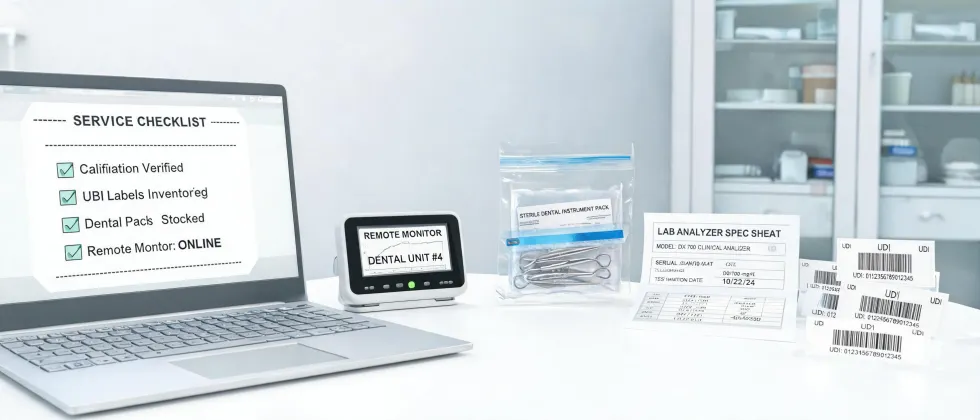
I'm the person who reviews medical equipment orders before they ship. Not as a clinician—I'm a quality and compliance manager at icare, a medical device supplier. I check several hundred order packages a year, and in the last 12 months I rejected roughly 9% of first submissions. Most weren't rejected because the device was bad. Let me be clear: I do not mean the device itself is bad. They were rejected because the specification around the device didn't match reality.
It took me four years and about 600 order reviews to understand what should have been obvious: a device order is not a catalog choice. It's a set of assumptions. When those assumptions are wrong, no amount of product quality fixes the outcome.
Consider a power wheelchair. On paper, it's the right model. Weight capacity works. Battery range works. Seat looks fine. Then it arrives, and the seat width is two centimeters narrower than the transfer space. The chair can't get close enough to the bed. The user can't transfer safely. On paper, every box was checked. In the hallway, it's wrong.
I see the same pattern with portable oxygen concentrators. A clinician writes 'portable oxygen concentrator' on an order, maybe with a flow rate. But a POC is not a standard oxygen tank. Pulse-dose trigger sensitivity, continuous-flow level, battery options, alarm behavior, carrying system—all of these change which device is appropriate. If you choose from a generic checklist, you're kind of guessing. Patients notice.
But the deeper problem is that many equipment decisions are still made the way they were in 2019. And 2025 is a different world.
The Deeper Problem: We're Specifying Equipment Like It's 2019
Between 2019 and 2025, medical devices changed more than many procurement processes changed. Devices now report remotely. They integrate with electronic health records. They include software that needs updates and accessories that need tracking. The fundamentals haven't changed—a wheelchair must safely support a person, an oxygen concentrator must deliver the prescribed amount of oxygen, and an ablation catheter must be safe and effective. But execution has transformed. What was best practice in 2020 may not apply in 2025.
So why do specs stay stale? In my experience, three causes show up again and again.
First, product-centric checklists replace workflow thinking. We ask 'Which item?' instead of 'What has to work?' A catheter ablation kit is a good example. If someone asks what is catheter ablation, the common answer is that it's a minimally invasive procedure used to treat abnormal heart rhythms by destroying the tiny area of heart tissue causing the problem. That's true. But for the supply chain, it's a system. Sheaths, catheters, mapping cables, and sterile packs have to match the lab's existing platform. If the lab upgraded its mapping system in 2023 but the purchasing template was last updated in 2019, the mismatch eventually shows up mid-procedure.
Second, one template gets applied to every site. I've seen an icare medical clinic with a small outpatient team try to use the same contract language as a 300-bed hospital. Same product, very different workflow. A hospital has backup devices and extra chargers; a small clinic often doesn't. The equipment spec has to account for that. 'Standard package' isn't standard.
Third, the last-mile details are underweighted. Sterilization compatibility, battery chargers, mounting brackets, spare filters, firmware updates. The purchase order lists the main device, but the device can't work alone. I once reviewed a portable oxygen concentrator order that included the unit but not the external charger. It wasn't a manufacturer mistake; it was a missing line on the customer's order. For a patient going home, that's not a small omission.
The Cost of 'Slightly Wrong'
The phrase I hear a lot is 'close enough.' In medical sourcing, close enough rarely is.
In 2022, I compared our rush orders against our standard orders over a full year. Rush orders were 40% more likely to be missing a required accessory. I don't have an academic study for that; I have our invoice data. But it's enough to make one thing clear: urgency is the enemy of specification quality. When someone calls and says 'we need it now,' the review is the first thing that gets shortened.
Back in 2021, we didn't have a formal verification process for customer-provided specs. It cost us on a 40-unit power wheelchair order. The customer confirmed the basic model, but the spec sheet didn't include the updated width measurement. We shipped the chairs, they were accepted, and then more than half sat unused because users couldn't get close enough to their beds or chairs. The dollar cost was bad—roughly $18,000 in freight and restocking. The trust cost was worse.
There's also the quieter cost of clinical time. When equipment doesn't match the environment, nurses and technicians are the ones who improvise. They find workarounds. They grab a different charger, swap an adapter, or make do. Most of the time, nothing bad happens. But when something does happen, it's rarely one dramatic failure. It's a chain of small assumptions that started in procurement.
What Is Catheter Ablation—and Why It Belongs in This Conversation
You might wonder why a quality inspector is talking about catheter ablation. Because it's a good illustration of the same problem.
Catheter ablation is a minimally invasive procedure used to treat arrhythmias. A doctor guides a thin tube from a vein in the leg up into the heart, then uses heat or cold to create a tiny scar that blocks abnormal electrical signals.
It's a routine procedure in many hospitals. But it depends on a lot of things being exactly right: catheter size, sheath, mapping system, sterile packaging, backup supplies. If someone wrote 'ablation kit' on an order form without checking compatibility with the lab's system, that order might look fine on the invoice and be useless in the procedure room.
So when I see 'what is catheter ablation' in a search query, I read it as a clinician or administrator doing their homework. Good. That's exactly the right starting point. The mistake isn't asking the question. The mistake is stopping before you ask, 'and what does that mean for how we stock and verify the equipment?'
The Solution Is Less Complicated Than You Think
If most problems come from assumptions, the solution is to make the assumptions visible. Not to buy the highest-spec device. Not to add more inspection steps. Just to close the gap between what's written and what's true.
Write the workflow first. Before you choose a power wheelchair, write down body measurements, door widths, transfer routine, and surface types. Before you choose a portable oxygen concentrator, write down activity level, typical use time, backup power plan, and oxygen setting. Before you order supplies for a catheter ablation lab, write down the installed platform, sterile process, and backup strategy.
Run a small pilot before the big rollout. If you're new to a supplier, start with one unit or one order. This is where an icare coupon code 2025 first order can genuinely help—not because a coupon should drive clinical decisions, but because it lowers the cost of testing your assumptions. Apply the code after you've written the spec, not before.
Make verification a routine, not an exception. ISO 13485:2016 describes design verification as confirming that design outputs meet design input requirements. You don't have to be a manufacturer for that idea to apply. Every equipment order is effectively a design output. Check it against the real-world inputs.
At icare, that's the part I care about. I've reviewed products across patient monitors, dialysis, dental, imaging, mobility, and more. The portfolio gives us perspective. But what matters on every order is whether the item matches the situation. Whether you're running an icare medical clinic, a dental office, a home-care program, or a hospital system, the same rule holds: build the process for the person who'll actually use the device. The best device in the catalog is only as good as the specification that brought it through the door.