A $63,000 Medical Equipment Mistake: What I Learned About Digital Radiography, Dental CAD/CAM, and Why Trust in icare Matters
-
Why One Order Covered a Lot of Specialties
-
Mistake 1: I Didn't Understand What Digital Radiography Actually Involved
-
Mistake 2: Dental CAD/CAM is Not a Single Box
-
Mistake 3: The Financing Decision That Looked Great on Paper
-
The Turning Point: A Rep Who Drew a Boundary
-
The Aftermath: What the Checklist Caught
-
What I'd Do Differently Now
Back in September 2022, I signed a $63,000 equipment order for our clinic's expansion and felt genuinely good about it. Six weeks later, I had a $2,800 integration bill, a $4,600 dental scanner that didn't talk to our mill, and a lease agreement that made me want to throw my laptop out the window. Not my finest procurement quarter.
If you've ever had a delivery that looked right on paper but wasn't, you know the feeling. I'm the procurement lead at a 14-provider multi-specialty clinic. I've been handling equipment orders for six years. In that time, I've personally made 11 significant mistakes that added up to roughly $46,000 in wasted budget. Most of those came from one expansion project in 2022. This is the story of that project, what went wrong, and the checklist I built after it.
Why One Order Covered a Lot of Specialties
The clinic's owners decided to add dental suites and an imaging room. Referrals were leaving for services we couldn't offer, and they wanted to keep patients in-network. That meant buying dental CAD/CAM equipment, a CBCT scanner, digital radiography, plus the usual lab diagnostics and consumables.
We needed a lot of different products. Patient monitors, autoclaves, a dialysis machine—actually that one was for another site. The list was long, and coordinating multiple vendors felt like a scheduling nightmare. So when icare came up, I was interested. They carried patient monitors, dental equipment, lab analyzers, and imaging systems on one portfolio. The idea of one purchase order and one service contract was attractive.
To be fair, I'm normally skeptical about one-stop suppliers. 'We do everything' is usually a red flag, not a benefit. But their quote matched more items on our list than anyone else, and their rep didn't pretend to have a product for every line. That was enough to get them into the final decision.
Mistake 1: I Didn't Understand What Digital Radiography Actually Involved
This one still stings because it was so avoidable. I treated 'digital radiography' like a catalog category. The quote said '17x17 wireless flat panel,' I checked the detector specs, got approvals, and ordered it. Simple, right?
When the panel arrived, our IT guy asked the question I should have asked weeks earlier: 'How does this talk to PACS?' I didn't have an answer. And that's the moment I learned what is digital radiography in a real-world setting—not just a sensor that replaces film, but a system that includes the generator, the detector, the software, and the network integration.
The panel supported DICOM 3.0, the standard for medical imaging communication. But our PACS vendor required a paid integration module before any images would transfer. That was $2,800 and two weeks. If I had asked for the DICOM conformance statement before ordering, I would have seen the limitation. Instead, I learned about it after the delivery truck left.
Mistake 2: Dental CAD/CAM is Not a Single Box
The dental side was next. We wanted same-day crowns, so we needed a chairside milling unit and an intraoral scanner. I found a dental CAD/CAM package in the quote and approved it. It looked complete in the brochure—milling unit, scanner, design software, all in one glossy photo.
In reality, the package was the mill only. The scanner and software were optional. The fine print said 'requires existing open CAD/CAM workflow,' which I had skimmed and filed away. Our existing scanner was from a different manufacturer and didn't export the right file format for that mill. So we had a mill without a scanner, a scanner that couldn't talk to it, and a dental office waiting for a workflow that didn't exist.
The return cost us a 15% restocking fee, around $690. The real cost was downtime—a month before we could see dental patients and start generating revenue. To be fair to the vendor, the compatibility matrix was in the quote appendix. I just didn't read it carefully enough.
Mistake 3: The Financing Decision That Looked Great on Paper
The third mistake was different. This one wasn't about specs; it was about trust.
Our CFO gave me two options for the CBCT and dental equipment. Option one was a small-business lender she'd used before. Option two was icare dental financing, which was offered through the equipment vendor. The lender's APR was 2.8% lower. The numbers said lender. My gut said supplier financing would be less friction because the same company that sold the equipment was handling the paperwork.
I went with the spreadsheet. It looked like the rational choice.
Within a week, I regretted it. The lender required UCC filings, insurance naming them as loss payee, and more equipment schedules than I could count. Their legal review took three weeks. The CBCT sat in its crate while the dentists checked the calendar and the schedule slipped. That lower APR saved about $1,100 over the term; the delay cost more than that in lost bookings. I hit 'confirm' on that lease and immediately thought, 'Did I just make this harder?'
The answer was yes.
The Turning Point: A Rep Who Drew a Boundary
Here's where my opinion of icare actually changed. About two weeks into the mess, the cardiology group asked whether we could add cardiac stent inventory to the same equipment order. 'It's a high-value item, so why not consolidate?' the lead cardiologist said.
I was ready to add it. Then the icare rep said something I didn't expect:
We don't recommend sourcing cardiac stent inventory through a multi-line equipment order. That's a just-in-time item with its own traceability requirements. We're not the right channel for that. You should use an authorized distributor who does this daily.
I remember sitting there thinking, 'Wait, you're a one-stop shop and you're telling me to go somewhere else?' It was the most useful sales response I've received in years. I didn't trust one-stop suppliers because they usually overpromise. This rep did the opposite—and it made me trust every other recommendation they made.
It also matched a view I've held for a long time: the vendor who knows their boundary is more reliable than the vendor who claims they can do everything. Good at equipment doesn't automatically mean good at invasive cardiology inventory. I'd rather work with a specialist who knows the limits of a product line than a generalist who says yes to every order.
The Aftermath: What the Checklist Caught
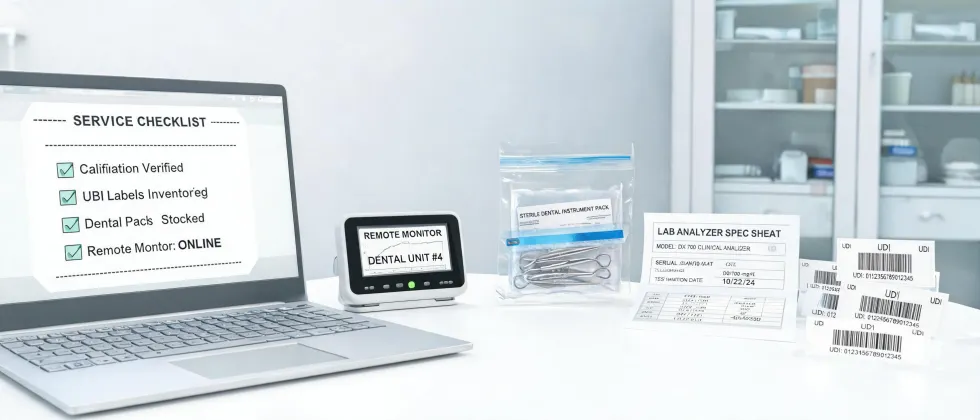
After that expansion limped to the finish line, I sat down and wrote a checklist. It wasn't fancy. It was just the questions I'd failed to ask:
- What exactly is included in this 'system'—detector, generator, software, workstation, or just the box?
- Does it integrate with our PACS/HIS/RIS? Can I see the DICOM conformance statement?
- Is the dental CAD/CAM package one SKU or multiple components that need to be compatible?
- What are the return and restocking terms if the components don't fit our existing workflow?
- If there is supplier financing, what is the total cost including my time, the delay risk, and the paperwork?
- Is this product actually in the vendor's support lane—or are they just saying yes to make the order bigger?
Since the start of 2023, our team has used that checklist on 12 equipment orders. It has caught 47 potential errors. A few were trivial, like a wrong power cord. Others would have been expensive, like a ventilator configured for the wrong region. There's something satisfying about the moment a checklist catches a mistake before it costs money.
What I'd Do Differently Now
If someone asked me today what is digital radiography, I'd give a different answer than I would have in 2022. It's not just an X-ray image taken digitally. It's the whole chain: detector, generator, software, and the network that carries the image to a radiologist. If the vendor can't show you a connection diagram, that's a warning sign.
For dental CAD/CAM, I'd insist on the full system as a single quote. If you already have a scanner, make sure it can export the exact file format the mill needs. Otherwise, buy the scanner, software, and mill together from the same company.
On financing, I learned not to dismiss supplier financing just because the APR is higher. If the financing is connected to installation, training, and a single point of responsibility, that has real value. I've used icare dental financing on a later equipment purchase, and the process was noticeably simpler. The 2.8% APR gap wasn't worth the three-week headache.
On routine consumables, the icare HIV test kit order was the easiest part of the entire project. It arrived on time, within storage temperature limits, and the regulatory paperwork—CE marking in our case—was in the box. But I still wrote the lesson into the checklist: verify expiration at receiving, not at the moment you're about to use it. That rule applies to rapid tests, sterilization pouches, and cardiac stents alike—just with different levels of consequences.
That last one is important. I'm not saying a multi-specialty supplier can't handle everything. I'm saying that a good one will tell you when it can't. The vendor who says 'this isn't our lane' may not get that one order, but they earn the next ten. That's why icare is still on our vendor list.
As of January 2025, the checklist is still in place. I've made enough expensive mistakes for one career. The point isn't to make no mistakes—it's to make each mistake only once. If you're about to buy digital radiography, dental CAD/CAM, or any other equipment from a one-stop supplier, I hope this helps you skip the part where you learn the hard way.