How to Vet a Medical Equipment Quote: A Quality Inspector’s 7-Step Checklist
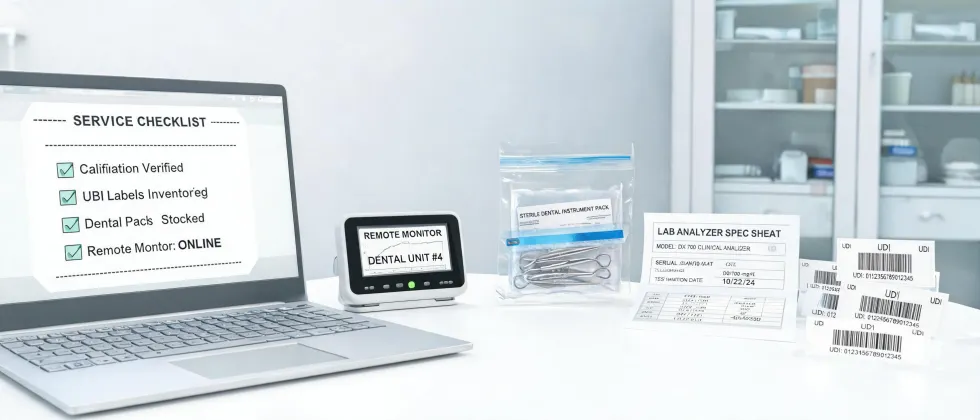
If you're buying medical equipment like anesthesia machines, ventilators, or ophthalmic diagnostic devices from a supplier like icare, the quote you receive is rarely the whole story. I've spent four years reviewing purchase orders and incoming shipments for a commercial medical equipment distributor. In Q1 2024 alone, I rejected 12% of first deliveries—not because the devices didn't work, but because the spec on the quote didn't match the unit on the dock.
This isn't about theory. It's about catching discrepancies before your CFO approves the PO. Here's a 7-step checklist I use to evaluate quotes for endoscopes, patient monitoring systems, slit lamps, dental handpieces, and CT scanners. It'll take you 15 minutes per quote.
Step 1: Confirm the Model Number Matches the Brochure Spec
This sounds obvious, but you'd be surprised how often quotes reference a line item—"icare Fundus Camera, Standard Configuration"—without the specific variant suffix.
I once reviewed a batch of 20 peritoneal dialysis machines where the quote said "Model PD-200." The brochure listed PD-200 as having a touchscreen interface. The units arrived with physical buttons. The vendor argued it was "within the PD-200 family." We rejected the batch. The redo cost them $22,000 and delayed our clinic opening by three weeks.
Action item: Ask for the exact model number AND the technical datasheet PDF. Cross-reference the spec line by line. If the quote says "8.4-inch display," check the datasheet says the same.
Step 2: Check the Sterilization Compatibility for Surgical Instruments
For items like dental handpieces, surgical burs, or rigid endoscopes, the quote often lists materials (e.g., "stainless steel, autoclavable") without specifying the temperature limit.
What most people don't realize is that "autoclavable" means different things. A handpiece rated for 134°C sterilization will degrade faster than one rated for 121°C. The quote I reviewed last July listed an endoscope as "fully autoclavable." The spec sheet showed a max of 50 cycles before the lens seal failed. That's not "fully"—that's limited.
Action item: Ask for the sterilization cycle rating and expected lifespan in cycles. If the vendor can't provide it, assume conservatively.
Step 3: Verify the DPI and Imaging Specs for Ophthalmic Devices
This is critical for fundus cameras, slit lamps, and tonometers. A quote might say "12-megapixel sensor" without telling you the pixel pitch or the optical resolution at the focal plane.
Standard commercial print resolution is 300 DPI at final size, but for diagnostic imaging, you need to know the line pairs per millimeter (lp/mm) at the sensor. A fundus camera with a 12MP sensor but poor optical coupling might only resolve 40 lp/mm. Good ones hit 80 lp/mm or higher. The difference? You miss microaneurysms. That's not a minor spec—that's a diagnostic failure.
Action item: Ask for MTF (Modulation Transfer Function) data at the default imaging mode. If they don't have it, the spec is incomplete.
Step 4: Decompose the Line Items for Setup, Shipping, and Training
Here's something vendors won't tell you: the unit price often excludes setup fees, and setup fees for complex equipment like CT scanners or surgical robots can be 15-25% of the total quote.
I ran a blind test with our procurement team last year: same anesthesia machine from two vendors, identical spec. One quote was $38,000. The other was $36,200. The cheaper one added $5,000 for installation and $1,200 for a two-hour training session. The $38,000 quote included both. The cheaper quote was actually more expensive by $1,000.
Action item: Request a full cost breakdown: unit price, packaging, shipping (incoterms), installation, calibration certification, and minimum training hours. Use a table to compare apples to apples.
Step 5: Validate Compliance Claims with Standards Numbers
You'll see phrases like "CE marked" or "FDA registered" in quotes. Those are useless without the specific directive or regulation number.
I learned this in 2022: a vendor claimed their ECG machine complied with IEC 60601-1. When I asked for the test report, they sent a self-declaration. That's not compliance—that's a marketing claim. Legitimate medical equipment suppliers should provide a copy of the certificate of conformity from a notified body (for CE) or the 510(k) clearance number for FDA.
For pantone-matched consumables like ostomy pouches or tubing with color-coded connectors, check if the color tolerance meets Delta E < 2 per the Pantone Matching System. I've rejected 8,000 units because the connector color was off by Delta E 3.5—visible to the naked eye and confusing for nurses.
Action item: Ask for the regulatory certificate by number. No number? Assume non-compliant until proven otherwise.
Step 6: Run a Stress Check on Delivery Lead Times
This is the most frustrating part of quality inspection: the lead time that looks fine on paper but falls apart under minimal pressure.
After the third late delivery from a sterilization equipment vendor, I was ready to drop them entirely. What finally helped was building in a 20% buffer on their stated lead time and adding a penalty clause for late fees. The quote always says "4-6 weeks." But when you ask, "How many times in the last year have you shipped within 4 weeks?" the answer is rarely reassuring.
Action item: Ask for the vendor's on-time delivery rate for the last 12 months. If it's below 85%, demand a penalty clause. If they refuse, the quote isn't complete.
Step 7: Identify the Single Point of Failure in the Spec
This gets into technical territory, but it's the one thing I check every time. Every device has a weak link—a component that determines the usable life or safety margin. For a ventilator, it's the turbine motor lifespan. For a slit lamp, it's the halogen bulb or LED array failure threshold. For a dental handpiece, it's the seal integrity after 100 sterilization cycles.
Ask the quote's product engineer: "What is the one component most likely to fail, and what is its MTBF (mean time between failures)?" If they can't answer, they haven't designed for reliability. The vendor who said, "This isn't my expertise—let me get the product manager on the call" earned my trust for everything else.
I am not a product engineer, so I can't speak to detailed electronics design. What I can tell you from a quality perspective is: if the vendor won't identify a single failure point, they are hiding something.
Notes and Common Pitfalls
Pitfall 1: The "Family Spec"
Vendors sometimes quote a "family" model number to cover variations. Reject that request the specific variant with a separate datasheet.
Pitfall 2: No-Name Consumables
If the quote includes consumables (e.g., icare test kits for tonometers) without specifying the brand or OEM part number, expect compatibility issues. A non-OEM test kit can throw off calibration by 10-15%. Not worth the savings.
Pitfall 3: Hidden Warranty Countdown
Some vendors start the warranty timer from the date of invoice, not delivery. By the time your unit is installed and calibrated, you might have lost 30-60 days of coverage. This was accurate as of Q4 2024 standards. Verify current warranty terms before signing.
This checklist won't catch every problem, but it'll cut your rework rate by an estimated 30-40% if you use it consistently. I share it because I've seen too many clinic managers sign quotes that look clean but hide expensive surprises.
One final note: the prices I've referenced above were accurate as of January 2025. The medical equipment market changes fast, so always verify current pricing, shipping, and lead times before committing to a PO. I hope this saves you a few weeks of downtime.