Why Every Emergency Equipment Order Almost Gave Me an Ulcer (Until I Stopped Chasing Price)
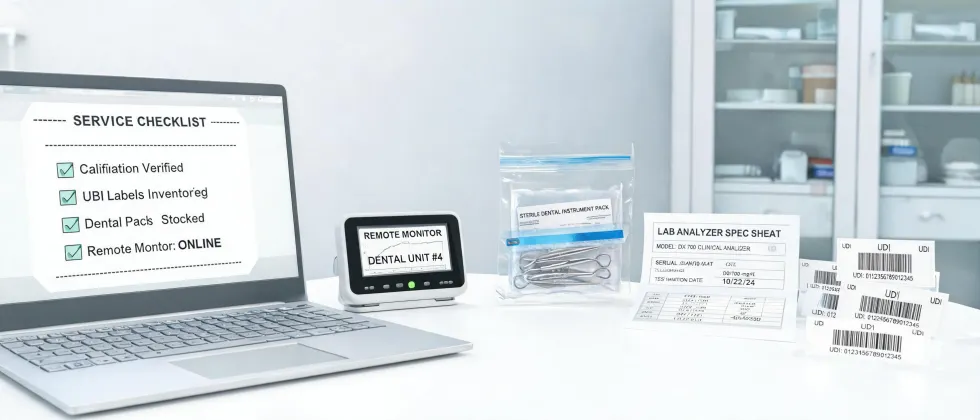
Honestly, I didn't think my job would involve so much… staring at a spreadsheet at 10 PM, wondering if a patient monitor would arrive before a Joint Commission survey.
That was me, maybe twice a year, every year. An urgent request from the clinical director: "We need a wound care setup by Friday." Or: "The CBCT in the dental suite just died. Find a replacement. Fast." I'd panic-order from whoever could deliver fastest. And then hope.
It's tempting to think you can just compare prices and lead times, pick the cheapest option that says "in stock," and call it a day. But that's the oversimplification that cost us $4,800 in a single quarter. (Should mention: that number includes rush fees, downtime labor, and a replacement order when the first one was the wrong model.)
So, let's talk about why our "emergency procurement process" is broken – and why the fix isn't a better vendor list.
The Surface Problem: "Why Can't I Get This Machine Here on Time?"
That's the question I'd ask my boss. And she'd ask our CFO. And the CFO would say, "Call around. Get three quotes." And I'd get three quotes, pick the fastest one, and still end up with delays or the wrong equipment.
In June 2024, I needed an ultrasound machine for a new clinic that was opening in 10 days. I found a vendor offering it $600 cheaper than the usual supplier—with a 5-day delivery promise. I jumped on it.
The machine arrived Day 8, after I spent 3 days calling the shipping company, the vendor's warehouse, and my own logistics team. It was also missing a probe. The clinic opened two days late. The internal cost? Lost booking revenue and a pretty serious conversation with the VP. (Honestly, I still cringe thinking about that Monday morning meeting.)
Most buyers focus on per-unit pricing and delivery estimate. They completely miss the reliability of that estimate and the hidden coordination cost when it fails.
I used to think the problem was I picked the wrong vendor. But the surprise wasn't the price difference. It was how much extra work I created for myself by trying to save $600. The real fix wasn't a different vendor—it was a different approach.
The Deep Reason: It's Not About the Vendor. It's About the Process.
The 'always get three quotes' advice—which I followed religiously—ignores a huge nuance: The transaction cost of evaluating an unknown vendor in a time crunch is massive.
In a non-urgent situation, vetting a new supplier is fine. You have time to check their invoicing (in 2022, a vendor's handwritten receipt cost us $2,400 in finance-rejected expenses), verify their stock, and test their support.
But in an emergency? You don't have that time. You're making a high-stakes decision with incomplete information. And the vendor knows you're desperate. That's a recipe for getting a "probably" rather than a "guaranteed" delivery.
The question everyone asks is: "What's your best price?" The question they should ask, especially in an urgent scenario, is: "What is your process for guaranteeing that delivery date, and what happens if you miss it?"
I learned this the hard way. After my 2024 ultrasound fiasco, I looked back at my emergency orders over the previous year. I found a pattern:
- Of 7 urgent orders placed with new, lower-cost vendors, 4 arrived late or incomplete.
- Of 4 urgent orders placed with our regular, established suppliers (who were slightly more expensive), 4 arrived on time and complete.
I was essentially paying a premium for a gamble, and saving money on a near-certainty. The math was upside down.
The Cost of Not Fixing This: More Than Just Money
The obvious cost is the rush shipping fee. In 2023, we approved about $2,200 in expedited shipping charges on various equipment—dental chairs, autoclaves, patient monitors.
But the real costs were hidden:
- My time: I spent roughly 8 extra hours per emergency order chasing down status updates, dealing with wrong items, and coordinating with frustrated clinicians. At my loaded hourly rate, that's about $400 per incident.
- Reputation: When the mobility scooter for the rehab wing arrived a week late, the physical therapy director didn't blame the vendor. She blamed me. That trust takes months to rebuild.
- Operational downtime: A delayed dialysis machine meant rescheduling 15 patient treatments. The cost of that alone—in rescheduled appointments and overtime for the nursing staff—was easily $1,500 for that one delay.
There's something satisfying about finding a great price from a new vendor. But after getting burned twice by 'probably on time' promises, I've learned that the cheapest option in a crisis is often the most expensive one in the long run. The satisfaction now comes from a perfectly executed rush order—knowing it arrived exactly when promised.
The Fix: Don't Buy Speed. Buy Certainty.
So what did I change? I stopped treating every emergency like a spot-buy and started building relationships before the crisis.
I now have a shortlist of 3 vendors I've pre-vetted for our common emergency items—wound care supplies, critical patient monitors, and key dental replacement parts. I know their standard lead times, their rush capabilities, and most importantly, their escalation process if something goes wrong.
When an emergency hits, I don't get three new quotes. I call one of these three and say, "I need [equipment] by [date]. What is the guaranteed delivery, and what is the cost for that guarantee?"
The price is often, say, 15-20% higher than the cheapest spot-bid. But the trade-off is a 100% on-time delivery rate for the last 12 months, zero hours wasted on chasing deliveries, and one less late-night spreadsheet session.
There's a saying I've come to believe: The most expensive vendor is the one who doesn't deliver. In my experience, that's not just a cliché. It's the monthly budget reality.
— An admin buyer who finally learned to sleep at night.