Icare Medical Equipment: A 3-Scenario Guide to Patient Lifts, Operating Tables, and More
There's no single "best" patient lift or operating table. If a vendor tells you otherwise, they're selling you a one-size-fits-all solution that probably doesn't fit anyone. The way I see it, medical equipment selection is a decision tree, not a yes/no test.
I've spent the last 12 years coordinating urgent medical equipment orders. In my role at icare, I've handled more than 200 rush orders—including same-day turnarounds for surgery centers and home care agencies. I've seen a $500 quote turn into $800 after shipping and setup fees, and I've seen the "cheap" option cost a client a full week of downtime. None of that is glamorous. It's just the background that shapes how I evaluate a buy.
The First Question: What Setting Is This Equipment Going Into?
Before you compare specs, sort out the care setting. This isn't about hospital versus clinic size. It's about workflow, staffing, and what happens if the device fails. Three scenarios cover most of what I see:
- Acute care and surgery centers.
- Home care, long-term care, and community health.
- Specialty clinics, dental, and veterinary practices.
Each scenario changes what "worth paying for" means. In one setting, the platform with the fanciest control panel wins. In another, a simple machine with a fast service path is the no-brainer.
Scenario 1: Acute Care and Surgery Centers
If you're buying for an operating room, the most important conversation often starts with a basic question: "how does anesthesia work?" People aren't usually asking for a pharmacology lesson. They're asking whether the table, the monitors, the IV poles, and the anesthesia machine will fit into the same workflow without making life miserable for the team.
Anesthesia works by acting on the central nervous system to produce unconsciousness, pain relief, and muscle relaxation—but from an equipment perspective, it means continuous vital-sign monitoring, airway support, and a table that can hold the patient in the right position. If the side rails get in the way of the anesthesia cart, or the outlet is on the wrong side, your team will have to improvise. In a busy OR, improvisation is a red flag.
The assumption I hear most often is that electric operating tables are always better than hydraulic ones. That's true in some places and false in others. In a high-volume hospital with reliable backup power, an electric table makes sense. In a smaller surgery center where the backup generator has never been tested under load, a hydraulic table may be the safer call. I'd rather have a table that still works during a power outage than one that gives me faster adjustment during normal days.
In March 2024, I got a call 36 hours before a surgery center's accreditation visit. Their discounted operating table arrived with a manual that didn't match the model, the brake release was seized, and the manufacturer's service tech was 300 miles away. We sourced a comparable hydraulic table from another vendor, paid extra for rush shipping, and they made the deadline. If we hadn't, the client would have missed the visit, triggered a compliance audit, and likely faced a penalty clause. The lesson? Vendor service proximity and documentation matter just as much as the table's specs. Put both into your cost analysis.
Scenario 2: Home Care, Long-Term Care, and Community Health
For home care, the patient lift is usually the largest single purchase. And it's the one where single-price thinking hurts the most. A $400 lift that takes 30 minutes to set up and has slings that don't fit your clients is not cheaper than a $1,200 lift your team can deploy in five minutes. I'm not saying buy the most expensive model. I'm saying run the total cost.
The old myth here is "you need a bariatric-capable lift even if you only have one heavier patient." That comes from an era when heavy-duty lifts were rare and renting was hard. Today, many suppliers offer weight-matched models, and some service packages include different sling sizes. The right move is matching the lift to your actual patient mix, not buying for a hypothetical that may never show up.
In 2023, one of our clients tried to save $600 on a portable lift and then found that the sling color-coding didn't match their team's training. It wasn't a disaster, but it cost them two days of staff time and an extra $80 for a compatible sling. Honestly, if you ask me, that's a textbook false economy.
If you don't have a biomedical team, look at icare home care services. Based on the orders I've handled, paying a bit extra for preventive maintenance and training is a no-brainer when the equipment is going into homes where no one can fix it on site. The CDC's Safe Patient Handling guidance also recommends mechanical lifts over manual lifting whenever feasible (Source: CDC, cdc.gov). One caregiver back injury can cost more than ten patient lifts.
Scenario 3: Specialty Clinics, Dental, and Veterinary
This is where the "we are not a hospital, so we don't need good equipment" thinking gets expensive. You do need good equipment. You just need less of it, and sometimes the portable or compact version is the better buy.
In veterinary practice, if you're measuring intraocular pressure, the Icare TONOVET Plus is worth a serious look. Rebound tonometry means you don't have to apply topical anesthesia to the eye, and in a busy clinic that saves time and reduces stress for both the animal and the technician. For a mixed practice, that kind of workflow gain matters more than a small difference in the purchase price.
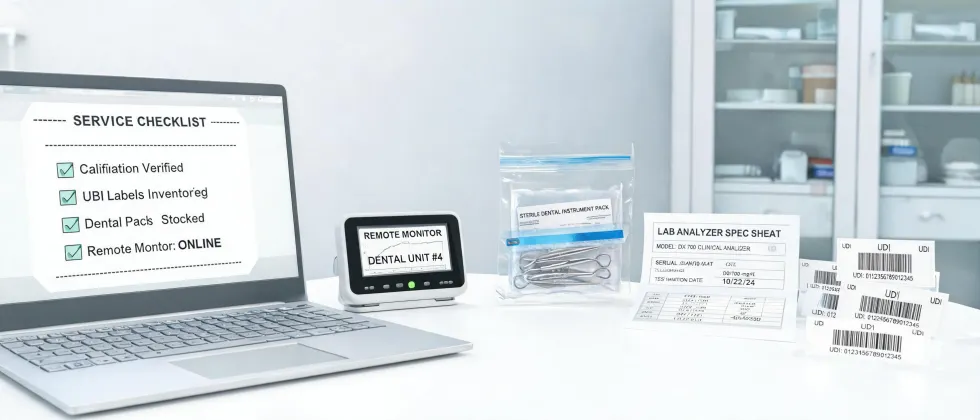
Dental clinics often ask me about compressors and CBCT units. For a single-chair practice, a mid-range compressor with a local service rep tends to be a better buy than a top-tier unit with no local presence. This one always surprises people, but a simple two-day fix with a local vendor beats a two-week wait for a premium national brand any day.
Take this with a grain of salt: calibration fees vary widely. But in the last year, I've seen quotes from $150 for a simple annual check to $700 for a multi-unit calibration contract (based on orders we processed for clients in Q4 2024). If a device needs periodic calibration—and most do—build that into the purchase decision before you sign.
How to Tell Which Scenario You're In
Here is the 10-minute way to decide:
- If your clinical team works around anesthesia equipment, vital-sign monitors, and an operating table all day, you're in Scenario 1. Prioritize compatibility, service response, and staff training.
- If your equipment is going to non-clinical caregivers in homes or long-term care, you're in Scenario 2. Prioritize ease of use, sling compatibility, and the provider's support network.
- If your patients come to a specialty clinic for a narrow set of procedures, you're in Scenario 3. Prioritize portability, calibration cost, and whether the device fits your actual exam workflow.
Still can't decide? Start with the failure mode. Ask yourself: "If this machine fails, what happens to the patient, the staff, and the schedule?" That question cuts through the marketing. The setting with the highest consequence should get the strongest support contract and the longest warranty. The setting with the simplest workflow can often get something smaller and lighter—and save the budget for training.
Don't hold me to exact model numbers, but the pattern I've seen across 200+ orders is consistent: the buyer who calculates the total cost of ownership over five years—purchase, setup, training, maintenance, downtime, and disposal—almost always makes the better call. That's why at icare we push the TCO conversation before we talk about price. It's not the easiest path, but it's the one that works.