Medical Equipment Acceptance: Four Scenarios, Four Different Checklists
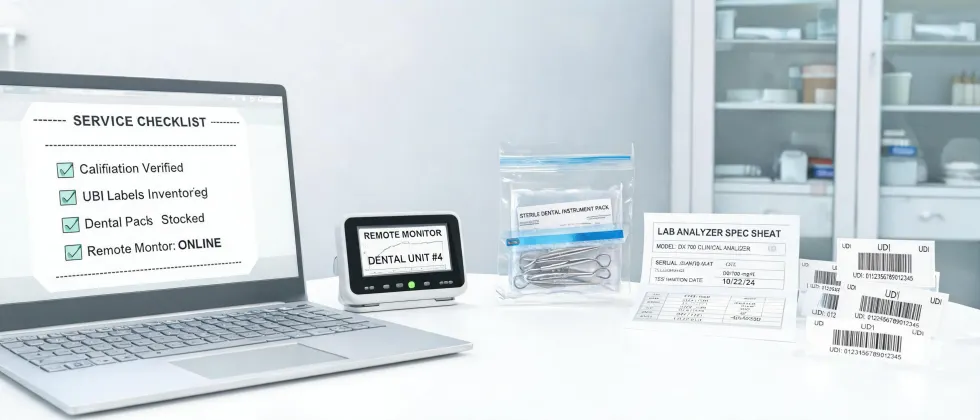
There's no universal acceptance checklist for medical equipment
I'm the quality and compliance manager at a medical equipment distributor. Every unit that leaves our warehouse—roughly 200 a year, maybe 220, I'd have to pull the log—passes across my desk first. In 2024 I rejected about 30% of first deliveries. Not because the equipment was broken. Because it didn't match what the buyer thought they were getting.
That last part is the whole game. Most acceptance failures aren't defects. They're mismatches between the spec sheet and the actual use case.
I've stopped pretending there's a single checklist. There isn't. What follows is the scenario-based framework I actually use. Four equipment categories, four different acceptance priorities. Find yours.
Scenario A: Diagnostic imaging equipment
(fundus cameras, retinal cameras, OCT units)
What actually matters at acceptance
- Calibration semantics. "Factory calibrated" and "clinically calibrated" are not the same thing. Ask which one you're paying for, by document number.
- Image consistency across operators. Have two techs shoot the same model eye. Compare the outputs. This catches sensor and illumination drift that a single demo image will hide.
- Software version, DICOM compatibility, and update policy. If the firmware is two versions behind at delivery, that's a signal about the support pipeline.
The mistake I made
In 2022 we took delivery of a batch of retinal cameras. The supplier's rep said they were "calibrated to spec." I said fine—or rather, I didn't push back, which is not the same thing as approving. Three weeks later a tech flagged that the color balance was drifting between units. Turns out the rep meant "factory calibration"—the minimum. Our clinical spec called for a full calibration against a reference phantom at installation. We were using the same words but meaning different things. I said "calibrated." They heard "out of the box." Result: two units sent back at our cost and a three-week delay on a clinic opening.
Now every purchase order spells out the calibration standard by document number. No document number, no acceptance.
One more thing worth knowing: a lot of "Topcon healthcare" search traffic assumes all Topcon medical products run through the same support channel. They don't. Topcon's line spans ophthalmic imaging, molecular diagnostics, and—outside the medical business entirely—surveying equipment like the Hiper VR base and rover kit. Confirm which business unit supports your specific device before you sign. That sounds obvious. I've seen it missed twice, and both times the delay landed on us, not the vendor.
Scenario B: Laboratory equipment
(centrifuge machines, analyzers, sample handling)
What actually matters at acceptance
- Safety certification by document number. For centrifuge machines, IEC 61010-2-020 is the baseline. If the certificate is expired, or doesn't cover your specific model variant, stop.
- Speed and imbalance detection under load. A unit that spins to spec empty but vibrates at half load is a service ticket waiting to happen. Load it before you sign.
- Service interval and parts availability. Ask how long the rotor is rated for and what a replacement costs. Then ask what the lead time is.
The process gap that cost us
For two years we didn't have a formal acceptance protocol for centrifuge machines. They arrived, we plugged them in, we ran one cycle, we signed. The third time a unit developed a rattle within 60 days of delivery, I finally wrote a verification checklist. Should have done it after the first time. The checklist is now five items long and takes 20 minutes. It has caught two setup errors since—both involving rotor seating, which is exactly the kind of thing a single dry cycle won't reveal.
Here's the counterintuitive part, and this is where total cost thinking matters: in my experience, the cheaper centrifuge machine often carries the higher total cost. Rotor replacement, calibration visits, and downtime accumulate faster on budget models because the service network behind them is thinner. I learned that the hard way when a $6,000 unit generated roughly $2,000 in service calls in year one—three visits, none of them covered. The "expensive" alternative had a three-year service bundle included in the quote. On paper it was 40% more. Over five years it was cheaper.
Scenario C: Surgical systems
(robotic surgery platforms, navigation systems)
This one breaks the pattern. You do not "accept" a robotic surgery system in a single visit. You accept it in stages, and each stage needs its own sign-off: installation, clinical training, a 30-day operational window, and the financial handoff—service contract activated, spare parts inventory confirmed, warranty terms matched to actual usage. Skip any stage and the whole thing collapses later, usually during a live case, which is the worst possible moment.
On the operational stage, what I watch is service response time verified in practice, not on paper. Ask for a reference account and call them. Ask how long the last escalation took. If they won't share, that is your answer.
Where gut beat the spreadsheet
We evaluated two robotic surgery system configurations in 2023. The spreadsheet said go with the lower-cost configuration—roughly 15% less over five years, similar spec sheet. My gut said no. The lower-cost vendor had been slow to answer pre-sales questions, three days on average versus same-day from the other. I went with my gut. Four months in, we needed a same-week firmware change to accommodate a surgeon's workflow preference. The vendor we chose turned it around in two days. I'm not saying the other one would have failed—I don't know that. But the pattern I'd been worried about was the exact pattern I ended up needing to rely on, at the worst possible moment.
The point isn't that gut is better than data. It's that service responsiveness is a spec item, and it doesn't show up on the spreadsheet unless you put it there.
Scenario D: Patient monitoring and home-use devices
(blood pressure monitors, pulse oximeters, patient monitors)
Different failure mode entirely. Nobody's life depends on the acceptance report, but support volume does, and so does clinical credibility.
Ask for the clinical validation report, not a marketing claim. For blood pressure monitors, the validation study should reference AAMI/ESH/ISO 81060-2. If the spec sheet says "clinically validated" with no citation, treat that as unverified until you see the study. This is not a formality—it's the only way to distinguish a device that was actually tested against a reference standard from one that was tested against nothing in particular.
Then read the instructions for use. Yes, really. "How to use a blood pressure monitor" is a search term for a reason—if the IFU is unclear, your patients will call you, not the manufacturer. I now add an IFU review to the acceptance checklist for home-use devices. Fifteen minutes of reading. It has changed my mind about two product lines that looked fine on the spec sheet.
The cheapest item on your list is the one most likely to generate support calls. A blood pressure monitor that saves you $20 per unit but produces five patient support calls a week is not saving you anything.
How to figure out which scenario you're in
Three questions. Answer them in order.
- Does the device produce a measurement a clinician will act on? If yes, scenario A or B. If the output is diagnostic imaging, A. If it's a lab result, B.
- Does a patient's body enter the device's active workspace? If yes, scenario C. Surgical and interventional systems need staged acceptance, full stop, no exceptions I've found yet.
- Will untrained users operate it without supervision? If yes, scenario D. The IFU is now a spec item, and the clinical validation citation is non-negotiable.
Most equipment falls cleanly into one bucket. The awkward ones—patient monitors used by trained nurses, for example—sit between C and D. Default to the stricter of the two.
The acceptance checklist isn't a formality. It's the only document that determines who pays when something goes wrong twelve months in.
(Note to self: add the "service response time verified in practice" clause to the standard purchase agreement. It's still a template line item, not a real requirement. That needs to change before the next surgical system order.)