We 'Saved' $18,000 on Medical Equipment. It Cost Us $28,000.
What I thought the problem was
If you've ever worked procurement in a hospital or surgical center, you know the drill. Three quotes come in. You sort them by total price. You pick the lowest number that doesn't scream 'obviously bad.' You feel responsible. You feel like you did your job.
That's what I did for the first eight years of my career. And that's exactly how I ended up sitting in front of our medical director in 2022, trying to explain why a purchase that saved us about $18,000 up front had quietly grown into a $28,000 problem.
I still keep the notebook. Eight years of 'savings' that turned into something else. Three of those mistakes cost us enough that I now use them as case studies when I train new team members. Here's what I learned — the hard way.
Why the cheap quote looks cheap
The first thing nobody tells you: a quote is not a cost. A quote is a snapshot of one line item — usually the unit price at the moment of purchase. Everything else lives outside the quote. And in medical equipment, everything outside the quote is where the money actually goes.
Here's what I didn't account for in those early years:
- Consumables and accessories. A cheaper surgical generator often locks you into proprietary handpieces. The generator looks like a bargain until you realize each replacement handpiece costs $350-$750, and you need 20 of them.
- Warranty exclusions. A lot of low-cost vendors cover 'manufacturing defects' but not 'clinical use.' In practice, that means the first time a device fails on the floor, they tell you it's your problem.
- Downtime cost. A patient monitoring system that goes down for two weeks doesn't just need repair. It needs a rental unit, additional nursing coverage, and a whole lot of manual charting that nobody has time for.
- Training gaps. The cheap option often means 'here's a PDF, good luck.' Your staff figures it out eventually — usually by making mistakes on real patients.
- Supplier stability. This one took me years to appreciate. A merger, a restructuring, a sudden change in service coverage — these things ripple into your supply chain months later. In 2023, when Globus Medical completed its merger with NuVasive, our spine surgeons immediately asked me the same question over and over: 'Are my instrument trays still going to work with the new service setup?' That's the kind of question a unit price never answers.
That last point has become something I check obsessively now. I have a column on our vendor scorecard I call the Globus Medical condition — basically, an assessment of the company's stability, recent M&A activity, and any service-level changes that might hit us six months down the road. I know it sounds dramatic. But I've been burned by a 'stable' vendor that turned out to be two weeks from being acquired, and I'm not doing that again.
I also started tracking what our surgical team calls Globus Medical spine acquisitions sentiment — meaning the general mood among our spine surgeons about how recent acquisitions in the spine device space are affecting their workflows. It's not a formal metric. It's just three or four conversations I have every quarter with the surgeons who run our spine program. But those conversations have saved me twice from signing contracts I would have regretted.
What it actually cost
The walker order
In 2021, we needed 40 walkers for our elderly rehab wing. Our standard model — a reinforced aluminum rollator we'd used for years — was running about $52 a unit. A supplier came in at $22. The math was obvious. We bought 40 of them and congratulated ourselves on saving roughly $1,200.
Three months later, 22 of the 40 had failed. The frame welds cracked on the cheaper model — especially around the seat joints, where elderly patients put the most weight. We replaced 22 walkers at $26 each (slightly more than the original price, because the supplier had cleared out that model), but the real cost was elsewhere. Two caregivers spent a combined 40 minutes per walker on swaps and incident reports. And then one patient fell while leaning on a cracked walker — no serious injury, thankfully, but the incident triggered an internal safety review that tied up our risk management team for two weeks.
Total additional cost: around $2,800, against a 'saving' of $1,200. Net loss of about $1,600. And I had a safety report with my signature on it.
The patient monitoring system
This one hurt more. In late 2021, we replaced 12 patient monitoring systems. A brand we'd used before quoted about $4,200 per unit. An alternative came in around $3,000. That's $1,200 per unit, $14,400 total. My director was thrilled. I was thrilled. We signed.
By month eleven, six of the twelve had battery issues. The vendor's warranty covered 'manufacturing defects' for six months — we were past it. Replacement batteries: $380 each. But the worse problem was the alarm integration. The cheaper monitoring system didn't play nicely with our existing central station. Nurses had to manually transcribe vitals during every rounds check — which meant roughly two extra hours of documentation per shift.
Over four months, that added up to about $4,000 in nursing overtime alone. Plus $6,600 to rent six replacement monitors while three units were sent for repair. Plus $4,560 for new batteries. Plus $3,600 in 'expedited' repair fees the vendor charged because the failures weren't covered under warranty.
Total additional cost: $18,760, against $14,400 in 'savings.' Net loss of $4,360 — plus a near-miss where an alarm was delayed because the integration failed, which our risk team had to document.
The surgical energy devices
In early 2023, we needed a new set of energy devices for our laparoscopic procedures. The premium brand — the one our surgeons had used for years — quoted $1,200 per generator and $400 per handpiece. The budget alternative came in at $800 per generator and $350 per handpiece. We bought four generators and 20 handpieces. Direct savings: $2,600.
Two weeks later, a handpiece failed mid-case — during a laparoscopic cholecystectomy. The case was already underway. The surgeon had to finish with a backup device (which we didn't have, so we borrowed one from the OR next door). The patient was fine. The schedule wasn't.
Rescheduling cost: roughly $4,200 in OR idle time and staff shuffling. Then two more handpieces failed over the next month. At that point, we switched back to the premium brand — after eating the cost of the cheaper units entirely. Total additional cost: about $5,250. Net loss of around $2,650.
I want to be careful here: I'm not saying every budget device is bad. Some are genuinely fine. But the math that matters isn't the quote. It's the quote plus what happens after.
What I do now (and it's not complicated)
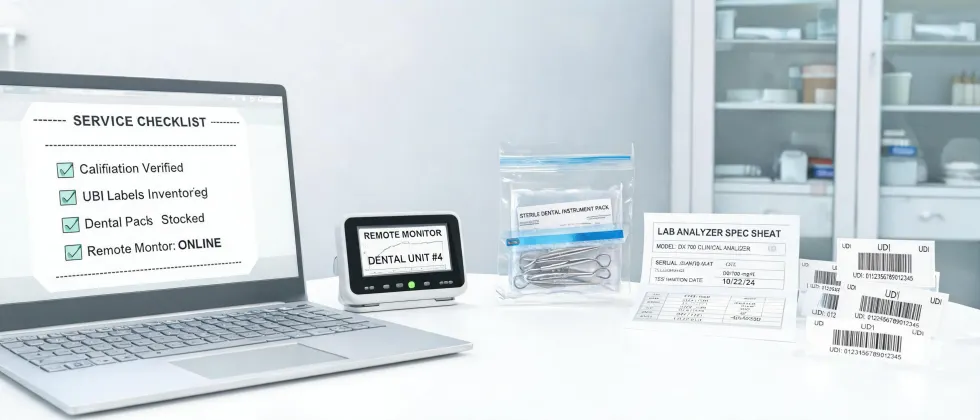
I don't have a fancy procurement framework. I have a one-page checklist that I run through before any purchase over $5,000. It takes maybe ten extra minutes per purchase. It has saved us — conservatively — somewhere north of $40,000 in the last 18 months.
Here's what's on it:
- Accessory cost for 24 months. Not just the purchase price. The handpieces, the batteries, the replacement cables, the proprietary connectors. If a vendor won't give me a 24-month accessory quote, I walk.
- Warranty, in plain language. 'Five-year warranty' means nothing until I see the exclusions list. I ask for it in writing before the PO goes out.
- Downtime plan. If this device goes down, what's our backup? Who pays for a rental? How long does repair typically take? If the vendor can't answer in specific terms, that's a warning sign.
- Integration requirement. For monitoring and anything that connects to our EHR, I ask for a compatibility checklist — not a demo. A demo shows what works in a controlled room. A checklist shows what works on our floor.
- Supplier health. The Globus Medical condition column again. Any recent mergers, regulatory actions, or service team restructuring? I'm not looking for perfection — I'm looking for honesty about what's changing.
None of this is glamorous. It's the same lesson any experienced procurement person will tell you if they've been at it long enough: the cheapest quote is often the most expensive decision. It just takes a few painful stories to actually believe it.
I do now. And I have a notebook to prove it.