We Bought a $4,700 Portable Ultrasound That Became a Paperweight — And the 6-Point Checklist That Stopped Me From Repeating It
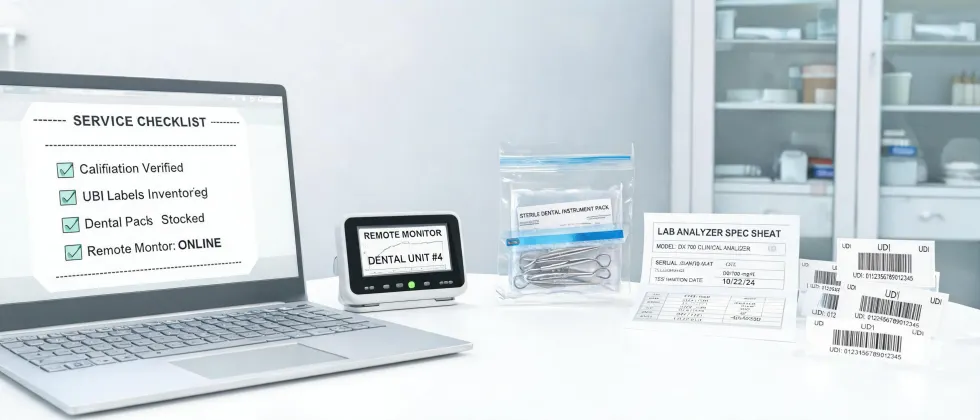
The portable ultrasound arrived on a Thursday afternoon in March 2021. I powered it on. Screen lit up. Transducer connected. Then our sonographer walked over, looked at it, and said: "That's a 3.5 MHz transducer."
My heart sank. About 90% of our abdominal imaging relied on 5 MHz transducers. The $4,700 machine sat in our supply room for three weeks waiting for a replacement unit. It was the most expensive paperweight I've ever purchased.
For two days, I blamed the distributor. Then I pulled the purchase order. The person who filled it out (me) wrote an ambiguous spec. The distributor confirmed exactly what was written. Nobody thought to circle back with "wait, 3.5 or 5?"
That mistake taught me something counterintuitive. Most medical equipment errors I've seen or committed didn't come from corner-cutting or dishonest suppliers. They came from one side assuming the other had the same version of the spec — when nobody actually did.
I manage about $400,000 of equipment budget. I've made at least six preventable mistakes against it. That's slightly over $10,000 wasted, every dollar documented. Here are the ones I'd want a time machine for.
Equipment failures are rarely equipment problems
The process goes like this: clinical team describes what they need → procurement translates that into a spec → distributor confirms → manufacturer ships. Three hand-offs. Three translations.
In my first year (2017), I made the classic "standard configuration" error: I assumed "standard" meant the same thing to every vendor. It doesn't. The same word can mean four thumb screws and no cable in one dealer's language, and full accessory kit plus extended warranty in another's.
The bigger the OEM, the more this matters. Take Globus Medical. Their public filings as of early 2025 show roughly 8,000 employees worldwide — spanning manufacturing, sales, clinical support, and order processing. A clinical rep in one region (an Associate Spine Specialist-type role, perhaps) may know exactly which implant set fits a specific case. But they don't write purchasing orders. The person who does is often in a different department on the dealer side. Information expires in transit.
That's the hidden truth. In medical equipment procurement, the equipment is rarely the problem — it usually does what it says on the spec sheet. The problem is in the translation gap between "what you actually needed" and "what got written down." You blame the wrong root cause, and the cycle repeats.
Another example. In 2018, I bought a set of automated blood pressure monitors, assuming nurses would figure them out in minutes. No training requested. I skipped it. Three months later, complaints about inaccurate readings started rolling in. Turns out nurses were using oversized cuffs and taking readings while patients were in various positions — some seated, some fresh off a staircase. Nobody had run the team through a proper "how to use a blood pressure monitor" orientation: cuff sizing, five-minute seated rest, all of it. The equipment was fine. The training gap wasn't. I spent $1,200 on a re-training session I could have avoided with a few clicks.
The cost is rarely just the money
Tally it up. That portable ultrasound error directly wasted $4,700 and forced a $800 rental while we waited three weeks. The blood pressure monitor mess cost $1,200 in re-training and roughly $800 in additional follow-up checks caused by misreads. The CT scanner mistake added $2,100 in expedited freight and about $1,000 in downtime. Add it up and you're past $10,000.
But those are the visible numbers. The invisible ones stung worse.
After two mistakes in a row, clinical teams stopped trusting my procurement judgment. A senior nurse started routing her requests around me. I became "the guy who buys the wrong stuff." It took over a year to rebuild that by running every purchase past the clinical team and confirming requests line by line.
Later, a more expensive one. In 2022, we ordered a replacement tube for one of our CT scanners. The previous one had been fine. The distributor said "same spec as before." We placed the order. Then a peak-hour scanning session exposed the gap — our actual volume required higher heat capacity than the standard replacement handled. Nobody asks that question on a standard order form. We paid $2,100 for expedited freight on top of roughly $1,000 in downtime.
Not anyone's fault, again. The tube worked. It just didn't work the way our actual environment required. The gap lived in the information — where nobody had written down "peak load, back-to-back scans, maximum throughput" in plain language. The paperwork said it was fine. The paperwork didn't know what our days actually looked like.
The checklist I now run on every order
I stopped getting surprised. Now every purchase order goes through the same six steps. Each one takes minutes. Each one has already saved a week.
- Write the clinical need in plain language first. Not the spec sheet — the scenario. Actual site conditions, actual volume, actual operator preferences. If you can't describe it in a paragraph, you don't know it yet.
- Force a written definition of "standard." Any time a spec says "standard," "typical," or "as needed," flag it yellow. Ask the supplier for their full accessory list in writing, item by item. If they push back, that's a red flag.
- Match the right person to the right question. The clinical rep who sells the product is rarely the person who writes the order. Get both on the same call and make them walk you through the spec together.
- Lock in training before the equipment arrives. Assume someone will use it wrong. Include training, re-training, cuff sizing, and patient positioning in the order — not as a post-purchase option. That $1,200 shouldn't have been mine to eat.
- Insist on use-case specs, not device names. Whether it's an MRI, a CT scan machine, or something as basic as how to use a blood pressure monitor — everything involves a real-world scenario. The specs that matter get derived from the scenario, not the brochure.
- Put acceptance tests on the packing slip. Write down what "arrived correctly" means. Don't cut the final payment until those tests pass. That's the one thing that's actually caught errors for me instead of documenting them after the fact.
Last year, the checklist caught 11 potential errors. One was almost another "standard" trap — a warranty clause on a CT scanner accessory that had quietly changed between the dealer's original quote and the final order confirmation. I wouldn't have caught that five years ago. I caught it this time.
If you take one thing from this: the biggest mistake in medical equipment procurement is assuming the problem is with the device or the people. The real problem is usually that no one was explicitly responsible for translating the spec from their world into yours. It's not a dramatic insight. But it's the one that actually saves money — and the expensive alternative is learning it the way I did.