Procurement Manager's Guide: Surgical Lights, Ambulatory Blood Pressure Monitors and Incontinence Products
-
The direct answer
-
Why I use an 'icare standards' checklist
-
Surgical lights: don't buy from a brochure
-
Ambulatory blood pressure monitor: start with validation, not price
-
Types of incontinence products: the list is not the strategy
-
The time my own rule failed
-
When I don't use the premium option
-
A practical record-keeping tip
The direct answer
Here's the procurement conclusion I'd give any buyer in a hospital, clinic, or aged-care setting: use a written standard to choose products, then calculate total cost over the expected life of the product. A low price on a surgical light, an ambulatory blood pressure monitor, or a case of incontinence products is irrelevant until you know the device is safe, validated, and serviceable.
That might sound like a management cliché, but I've been signing POs for six years. I manage procurement for a regional care group—about $2.4 million a year across medical equipment, consumables, and facility supplies. The checklist I use now started after I got burned on a 'cheap' option that wasn't cheap at all.
Why I use an 'icare standards' checklist
What do I mean by 'icare standards'? It's not a magic regulatory phrase or a premium-brand slogan. It's a practical four-point test I apply before a product gets a tender number:
- Regulatory and safety status. For a medical device, this means listing in the relevant market (TGA/CE/FDA) plus compliance with the right standard. For a surgical light, I ask specifically about IEC 60601-2-41.
- Performance evidence. A spec sheet isn't evidence unless the numbers can be traced to a recognized validation method. For BP devices, that starts with ISO 81060-2.
- Service reality. Where are spare parts stored? What is the maximum response time in writing? Is the service person local?
- Lifecycle cost. Hardware + software + cables + consumables + training + downtime + repair.
That last point is the one that usually separates a sensible purchase from a cheap one.
Surgical lights: don't buy from a brochure
I'm not against price comparison for a surgical light. But lights get evaluated with a surgeon in an actual room, not from a datasheet. Three years ago, we chose a lower-priced light because the published illuminance was slightly higher than the clinical team's first choice. We saved about $3,200 upfront. During the live setup, the light produced too much central glare and not enough usable depth in the cavity; the surgeon had to stop and reposition it constantly. The unit met its own specs. It didn't meet the workflow. We moved it to a minor procedure room and bought the correct light anyway.
Looking back, I should have insisted on the 30-minute theater test before we issued the PO. At the time, I trusted the numbers because they were in a professional brochure. Now I trust the clinical test.
A surgical light also sets the tone for the OR. If the surgeon has to fight shadows, the whole team feels it. You can't see that cost on an invoice, but you can see it in the faces of the staff at the end of a long list.
Ambulatory blood pressure monitor: start with validation, not price
An ambulatory blood pressure monitor records blood pressure over 24 hours. It's used to identify white-coat hypertension, night-time patterns, and treatment effects. Those clinical decisions are only as good as the data, so my first question is always: where is the validation evidence under ISO 81060-2?
If a vendor says 'clinically tested' but can't show a validation summary, I don't accept that. It doesn't mean the device is bad. It means the vendor hasn't given me a reason to trust it.
Once validation is confirmed, the price trap moves to the software and workflow. In a recent purchase, the lowest hardware quote needed a proprietary gateway plus an annual per-workstation software license. After four years, that 'cheap' system cost more than a competitor's slightly higher upfront device that worked with our existing clinical system. The hidden cost wasn't the device. It was the minutes a nurse spent on every download.
Types of incontinence products: the list is not the strategy
If you found this article looking for types of incontinence products, the basic map looks like this:
- Pads and shields: light bladder loss.
- Underpads and chair protectors: absorb liquid under a person or on a surface.
- Pull-up pants: people who can stand, walk, and dress themselves.
- Tab-style briefs: people who need assistance with changing.
- Booster pads: extra capacity added to another product.
The map is useful, but the procurement decision shouldn't be based on what category sounds familiar. It should be based on what happens with the people who will wear or use it.
We once bought a lower-grade brief to save a few cents per item. The direct product price went down, but staff changed products more often, laundry went up, and we used more skin wipes. After we tested a better-fitting absorbent product on two wards, the net cost per patient-day dropped by 11% and the night shift reported fewer unplanned changes. If my budget review only compared unit prices, I would have missed that.
Incontinence products affect dignity. Families and patients judge a facility by whether the bed is dry and the product works. That is not a soft issue. It is quality perception, and it has an operational cost.
The time my own rule failed
This checklist doesn't make me perfect. Last year, I approved a surgical light after confirming the vendor had local technicians. I didn't ask whether the critical spare parts were actually stocked locally. When a control board failed, the part had to come from overseas and the light was down for nine days. The local technician couldn't fix the problem without a part that wasn't there.
I knew I should have requested a written parts holding list, but I assumed the word 'local' was enough. It wasn't. Now every quote must state the location of critical spares and the response time in writing.
When I don't use the premium option
There's a difference between quality and over-buying. A small treatment room that does routine examinations doesn't need an OR-configured surgical light; it needs a safe, certified light that fits the procedure. A pharmacy doing opportunistic BP screening doesn't need a 24-hour ambulatory blood pressure monitor if a validated upper-arm monitor meets the service goal. And a low-risk continence population may be perfectly well managed with a standard pad.
The point is not 'buy the most expensive product.' The point is to make sure the product is certified, validated, serviceable, and costed over time. The lowest appropriate quality is still quality.
A practical record-keeping tip
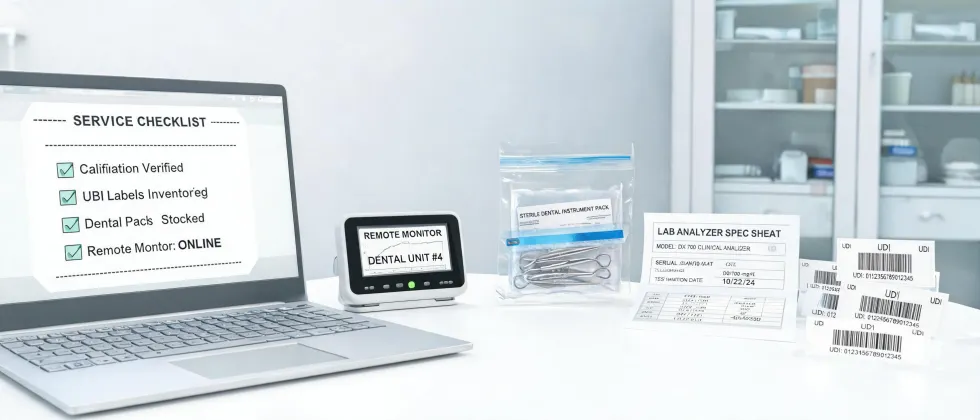
Finally, a practical step for anyone dealing with provider or distributor dashboards. The customer portal for our medical supply platform is labeled 'login icare' at the top of the page. I use it mostly for record keeping, not just ordering. Inside, I can pull up current certificates, warranty records, and order history. If no such portal exists, make a folder system and attach certificates to every PO. After an audit, you'll understand why.