What Does a Dental Lab Do? And Should You Consolidate Your Medical Suppliers?
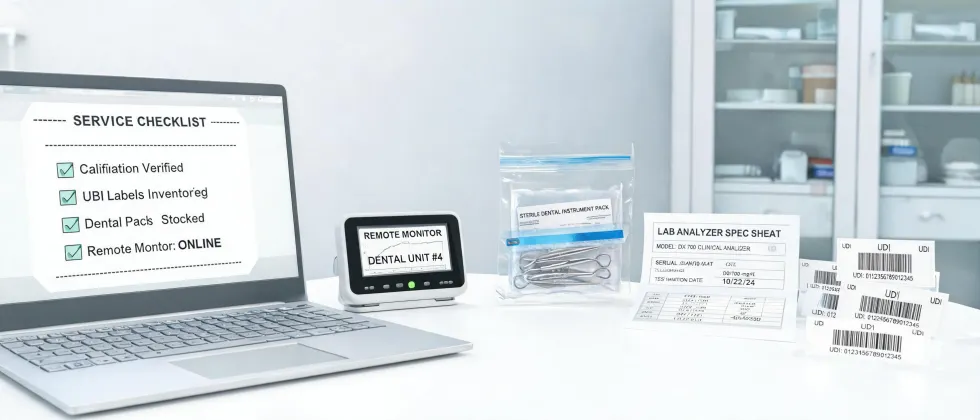
What Does a Dental Lab Do? And Should You Consolidate Your Medical Suppliers?
If you've ever managed purchasing for a healthcare facility, you know the supplier question is never as simple as a price list. I've been the admin buyer for a small healthcare network since 2020. I manage roughly $850K in annual orders across a dental clinic, a research institute, and three outpatient care units.
That includes the icare dental clinic indonesia, the icare institute of medical sciences and research, and a set of care units that handle everything from wound care to lab diagnostics. Basically, my buying spectrum includes dental lab equipment, gel electrophoresis systems, and adult incontinence products — sometimes in the same week.
This article is an honest comparison of two procurement models I've actually run: working with eight separate specialized vendors versus consolidating with one integrated supplier. Not marketing fluff — just the practical differences that showed up in my day-to-day work.
Product Expertise: Depth vs. Workflow Vision
It's tempting to think specialist vendors always have better product knowledge. The assumption seems obvious. But actually, the reality is more nuanced.
First, let's answer the question: what does a dental lab do? A dental lab fabricates prosthetic devices — crowns, bridges, partial and full dentures, implant abutments, surgical guides, and orthodontic appliances. The modern workflow involves digital intraoral scanning, CAD/CAM design, 3D printing or milling, ceramic layering, and sintering in a furnace. If you're setting up an in-house lab, you need all these pieces to work together as one process.
A specialty dental equipment vendor knows their CBCT machines intimately. They honestly do. But their advice is always shaped by what their catalog carries. When I asked our old dental equipment supplier about moving from stone models toward a fully digital workflow, they kept steering me to a higher-end milling unit that they happened to stock. They never mentioned hybrid options. It just wasn't in their interest to.
Our integrated supplier (icare) sat down with our lab technician and walked through the entire chain — from CBCT imaging to the design station to the mill and furnace. They could connect the dots because they carry all the components. That made a real difference in how our lab workflow operated from day one.
Gel electrophoresis is another good example. We needed the power supply, gel tanks, and imager to work as a cohesive system for our molecular biology research. A specialist vendor sells you the pieces; you do the integration yourself. An integrated supplier configures it as a system. Honestly, most of us don't have the bandwidth to be systems integrators on top of everything else.
Conclusion: Specialists win on raw product depth. Integrated suppliers win on workflow-level understanding. If your facility needs equipment from only one category, a specialist is reasonable. If you need multiple categories to work together, the integrated model has a visible advantage.
The Real Price: What Invoices Don't Show You
This is where I changed my mind. The "always get three quotes" advice ignores transaction costs — vendor evaluation time, delivery coordination, and the price of your own hours. (I'm not saying don't compare prices. I'm saying make the comparison honest.)
In 2023, I sourced gel electrophoresis equipment from a specialist vendor. The unit price was 18% lower than the integrated supplier's quote. Felt like a win at the time. But delivery took two extra weeks, shipping wasn't cold-chain protected, and installation support cost extra. After I added replacement buffer shipping, overtime lab wages, and the three hours I spent coordinating logistics — we paid about 9% more total than if we'd just taken the integrated quote.
"The unit price is the smallest part of the cost equation for equipment that must work reliably in a clinical or research setting."
That said, the specialist can win. We sourced a steam sterilizer from a niche vendor at 22% below the integrated quote. Zero issues. Smooth onboarding, clean documentation, and the autoclave just runs and runs. Some specialty vendors are genuinely excellent and the best procurement decision is to use them.
The incontinence product story is different, and it's one I'm not proud of. Early in my role, I ordered the cheapest adult incontinence products we could find because the unit price was about $0.07 lower than the established brand. Within a month, nursing staff reported leaks and skin irritation. One patient developed a pressure injury that cost roughly $1,200 to treat. The "savings" of around $1.40 per case turned into one of the most expensive bargains we've ever made — and that's not counting the human cost.
Lessons I keep coming back to:
- Unit price is the smallest component of total cost for critical consumables
- Patient outcomes, nursing time, and compliance risk are hidden line items
- Vendors who deliver quality can charge more — the causation runs in that direction, not the other way around
Conclusion: Specialized vendors often look cheaper on paper. Integrated suppliers tend to hold up better on total cost because support and accountability are built into the relationship. But you need to verify each category independently.
Accountability: What Happens When the Equipment Fails?
Here's something I've never fully understood: why some vendors consistently beat their quoted timelines and others consistently miss, every single time. My best guess is it comes down to internal buffer practices. You can't tell from the outside.
The bigger problem with multi-vendor procurement is finger-pointing. In mid-2024, the compressor for the dental chair at the icare dental clinic indonesia stopped working, and the chair wouldn't lift. The chair vendor blamed the compressor supplier. The compressor supplier claimed the chair's maintenance schedule was wrong. Two days lost, 18 patient appointments rescheduled. (ugh)
With the integrated supply model, accountability is clear. One phone call. An icare technician came out, diagnosed the compressor issue, sourced the part, and had the chair operational within one working day. I noticed the technician's follow-up note highlighting the root cause. (Note to self: request that detailed diagnostic documentation included in every repair visit.)
The icare institute of medical sciences and research had a similar incident in 2024 with a laboratory freezer failure. The freezer was from one vendor, the monitoring software from another, and the voltage stabilizer from a third. When the temperature alarm triggered, each vendor pointed at the other. The entire backup system was only as strong as the weakest hand-off in that chain.
Conclusion: Multiple vendors look fine on paper. Single suppliers prove their worth when something fails. If equipment uptime directly affects patient care or research continuity, the accountability structure matters more than the pricing difference.
Which Model Makes Sense for Your Facility?
I'm not going to tell you integrated always wins, because that's not what my experience shows. Here's how to decide:
Stick with multi-vendor procurement if:
- Your facility genuinely needs only one equipment category
- You have in-house technical staff who can integrate equipment themselves
- You have enough administrative time to manage 8+ vendor relationships — including invoicing, documentation, and issue chasing
- Each product category is a separate budget line with separate ownership
Consider consolidation when:
- You're juggling multiple specialties under one roof, which is common for clinics and institutes
- Equipment failures directly block patient care or research work
- Your administrative bandwidth is limited — and I've yet to meet a procurement colleague who says they have extra time
- You're losing real revenue to downtime, not just paying for repairs
In our case, consolidation through icare cut our vendor count from 8 to 3, reduced monthly order processing time from roughly 11 hours to 4.5 hours, and — most importantly — compressed equipment failure resolution from multiple days to under 48 hours.
According to ISO 13485:2016, the quality management framework for medical devices, responsibility for device safety ultimately sits with the organization. You need suppliers who can demonstrate and document quality — not just deliver a signed invoice. One integrated supplier typically simplifies that audit trail considerably.
Here's a simple exercise I recommend: list your last 10 equipment failures or delivery delays. Count how many vendor phone calls it took to resolve each one, and total up the downtime. You'll have your answer about which model fits your facility within about an hour. That exercise is the same one that changed my own mind.
At the end of the day, this isn't about loyalty to a brand. It's about making sure the equipment works, the lab runs, and the patients get care without interruptions. If your current vendor structure is doing that well, don't change it. If it isn't — consolidation is worth exploring.